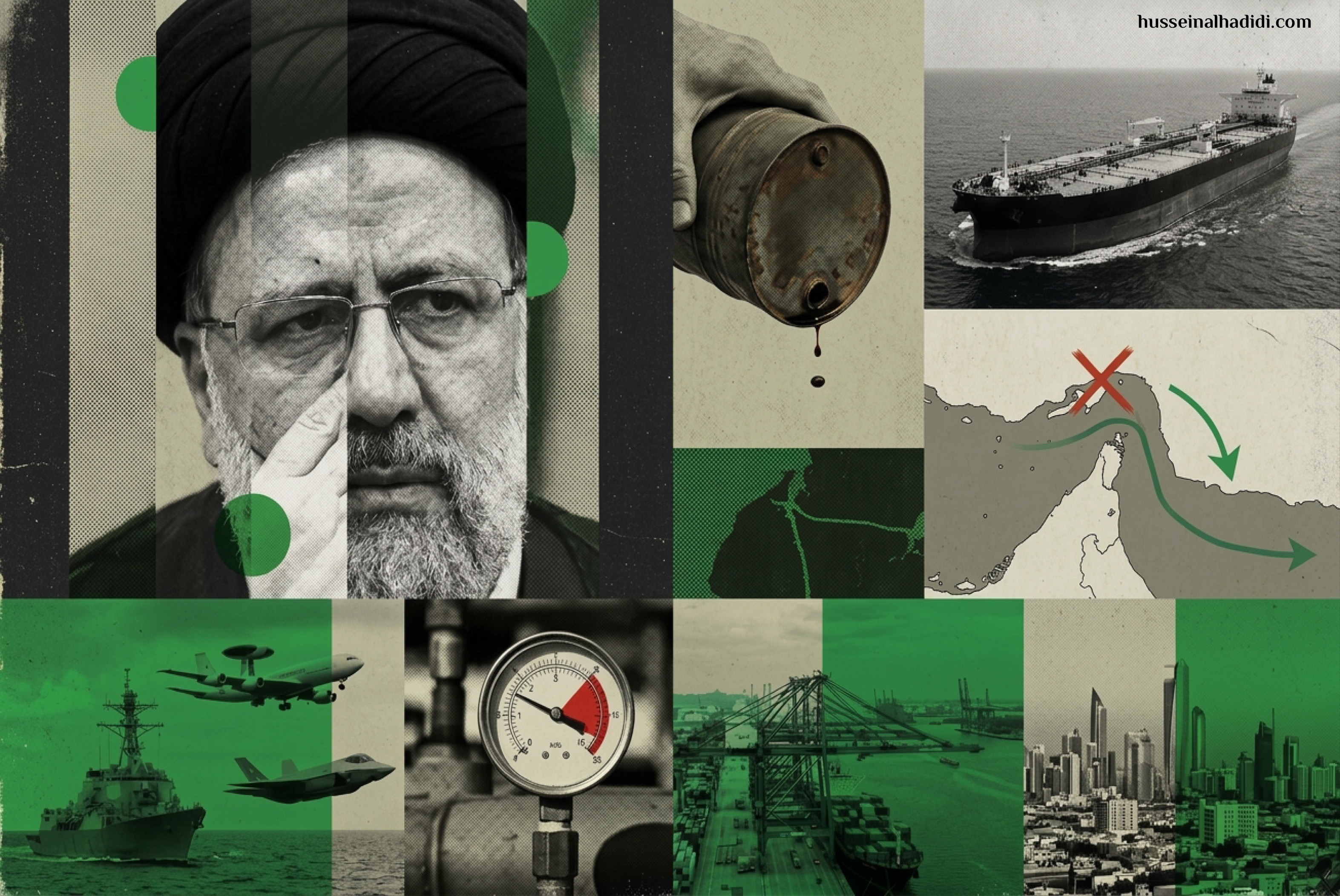
Out at sea, between the Strait of Malacca and the Chinese coast, Iranian tankers sit at anchor like floating treasuries. Some of them represent the last pressure cards Tehran holds over the global economy, and they are dwindling fast. According to estimates from tanker-tracking firms, Iranian crude afloat beyond the reach of the blockade has fallen to about 15 million barrels, down from 29 million at the start of September. That means supplies to China, which has been taking roughly a million barrels a day from Iran, could run dry in mid-October, or in late October if the figure is given a generous margin of optimism. Tehran therefore has weeks, not months.
### An Hourglass With No Sand
Since the Americans reimposed the blockade in July, Iran has lost the ability to load crude at Kharg Island and has been living off a floating stockpile it laid by before the war. Now that stockpile is itself running out. This explains what looked like a contradiction in Iran's behavior: an offer, made from the podium of the United Nations, to reopen the strait within seven days in exchange for the frozen funds, the lifting of sanctions and the end of the blockade, followed a few days later by a threat to strike infrastructure across the region. The two gestures are two faces of one coin. A man who sees the bottom extends one hand in greeting and hides a dagger in the other.
Trump answered with a refusal. Those who read that refusal as arrogance misread it. He believes the hourglass is working in his favor, and that every passing day brings Tehran closer to the edge of an empty storehouse. The matter, then, branches into two roads. Either Iran enters a new round of negotiations to refill its floating tanks and keep up its pressure on the Gulf and on the American pocketbook through diesel and gasoline prices, or its floating oil dissipates and it is left besieged with no source of supply. The second is the more dangerous, because an adversary with nothing left to lose no longer counts the cost of losing.
### The Strait That Opened for Everyone and Stayed Shut to Its Owner
The irony that stings the Iranians is that Hormuz is no longer what they intended it to be. Some 13 million barrels a day now pass through the strait, close to 77% of its pre-war level, a figure no one expected when the passage was closed months ago. The convoys are led by destroyers and covered by AWACS aircraft and F-15 and F-35 fighters, and the Gulf states have found routes that skirt the threat. The equation has turned against the party that once held the initiative: it retains the power to harm but lacks the power to seal.
Yet this success is fragile. It rests on an enormous daily American expense, estimated at 100 million dollars, and it cannot last indefinitely. Global stockpiles, whether America's strategic reserve or the commercial, European and Japanese inventories, have eroded to levels not seen in decades. The US Strategic Petroleum Reserve has fallen below 300 million barrels, its lowest since 1983. So long as the flow through Hormuz barely meets demand, every barrel drawn from storage is a barrel that does not return. Here lies Tehran's second point of strength: a world living off its reserves cannot withstand a new shock.
And consider China, the party that is absent from the headlines yet present in every equation. If Iran's floating oil runs out, where will Beijing make up its million barrels? It will go to the market and raise demand, and to Russian crude and enlarge Moscow's gains, and both roads push prices higher. China need not ally itself with Iran to become a pressure factor in Iran's equation; it is enough that it breathes its need.
### What Iran Can Do Without Fingerprints
If the noose tightens, Iran will have no need to close Hormuz a second time. It is enough to make insuring tankers so costly that movement is paralyzed, and to strike where it hurts: the refineries, the loading facilities, the pipelines, foremost among them the East-West pipeline, the artery of Saudi Arabia's bypass, and the port of Fujairah, the Emiratis' outlet. Iran's proxies have already tried this. The East-West pipeline has been attacked; the Houthis have extended their control over Mocha and now look out over the Bab al-Mandab; and their weapons, according to what the American press reports, can reach any point in the Middle East.
The Houthis are the only front that has gained ground. Their environment is favorable, their arsenal is plentiful, and their channels of cooperation with the Iranians and the Chinese are open. The most dangerous thing about this front is that Tehran can play a game of denial through it: militias acting on their own in a separate quarrel with the Saudis, so that the fire strikes its target and no hand carries a fingerprint. In this way escalation is turned into a strategic advantage while negotiation remains open.
Iraq is murkier than it appears. The last American soldiers withdrew from it only days ago, and Tehran celebrated the occasion as a victory. The regional circle widens further with the armed factions' pledge, according to leaks, to refrain from attacking the Americans for ninety days after the withdrawal. On its face this is calm; beneath it lies a deferred price. Whoever can afford to wait has no need to hurry. I expect Iraq to be the last front to move, and that the weight in the coming weeks will fall on Yemen and the Gulf.
### Washington: The War That Devoured Its Own Magazines
On the American side there is a flaw that official statements do not conceal. The war has consumed about two-thirds of the Patriot stockpile and nearly half of the THAAD stockpile; of the ATACMS and Precision Strike missiles, nearly all have been used, and the Tomahawk inventory has fallen by about a third. Patriot production does not exceed 600 missiles a year, meaning that rebuilding requires at least two years, closer to three according to experts, before Washington announced a plan to raise output to about 2,000 missiles a year over the following years. All this while Iran piles up drones and ballistic missiles, its strength accumulating during the truce and its capacity for surveillance and reconnaissance growing.
Here the military meets the electoral. Three weeks remain before the Knesset elections and a month before the midterms on November 3. America's diesel price, which broke through the 6-dollar-a-gallon barrier and reached a record peak of nearly 6.44, now stands about 71% above its pre-war level and strikes the rural states first, Trump's stronghold. The man himself has conceded that prices may not fall before the elections, and then went on to call their rise a "small price" for this war. That phrase alone is enough to read in it that the anxiety he tries to hide dwells within him.
Even so, Tehran's wager on the Republicans' fall may be overstated. The Democrats lack sufficient strengths on the inflation file, and Republican propaganda is able to redirect part of the public anger toward them. Moreover, the decision for war lies, in practice, beyond Congress's authority, so the elections may change the atmosphere but will not change the battlefield. Whoever awaits an effect that never arrives gambles with what little time he has left.
### Netanyahu and the Arithmetic of the Ballot Box
In Israel, voters head to the polls on October 27, and the surveys keep Netanyahu's bloc short of the 61-seat threshold. It is natural for the prime minister to wish for an Iranian strike before the vote, since a people pushed into combat rallies around its leader. But Iranian calculation does not run along that grain. It is not to be expected that Tehran will hand its adversary a free electoral gift, with its American targets available wherever it turns. Moreover, Trump himself has publicly rebuked Netanyahu for what he saw as defiance of the path to a settlement, so the man cannot drag Washington into a confrontation it does not want before it has finished with its own elections.
### Three Doors Out of the Room
The factors gather as clouds gather: no one has broken the other's will economically, the congestion of grievance is at its height, no military decision is in sight, Iranian strength is accumulating, Washington's magazines are exposed, and the oil market is fragile. When these are placed together in a single dish, nothing remains but an explosion, and the question is left of its shape and its timing. In my estimate there are three paths.
The first, and the most likely, is a calculated escalation led by the proxies. Attacks from Yemen and elsewhere on Gulf oil facilities, ports and refineries between mid-October and early November, unclaimed by Tehran and accompanied by offers of negotiation that keep the door open. Its aim is to raise the diesel price before the American elections and to extract a concession on the blockade.
The second is a partial agreement before mid-October that trades the reopening of the strait for an easing of the blockade in a formula that saves face for both sides. It would require Trump to retreat from his latest refusal, and decisive Chinese pressure on Tehran. It may not hold, since any stumble in implementing its terms would return everything to square one.
The third is a broad direct confrontation involving American bases, Gulf facilities and perhaps Israeli targets. It is the most dangerous and I do not rule it out, for one whose stockpile has run out and whose options have narrowed may see in explosion a way out. As for the remaining possibility, it belongs to exhausting stalemate, the continuation of things as they are.
Whichever path unfolds, there are indicators to be read before the hour: a sudden drop in Iranian shipping figures toward China, Houthi movement south of Hodeidah and along the Red Sea coast, an escalation in the Revolutionary Guards' rhetoric aimed at the American voter, and an American repositioning of additional destroyers toward the Arabian Sea. If two or more of these coincide, the hour has struck.
### Beyond the Week: A War That Leaves the Door Open to the Post-American Era
Many analysts hold that this may be America's last war in the Middle East. The military bases did not protect, the missiles ran out, the strategic exposure is plain across every theater of commitment, and no power can hold the world by all its edges. After withdrawal, a vacuum may form, to be filled by one of three things: an expanding Iranian influence, an Arab-Israeli alliance that confronts it, or a continuing war with no American patron, the most dangerous of them, because it removes every restraint from the game.
And here emerges the irony that no historian will overlook after a time: the United States, which entered the war to break Iran, found itself, months later, searching its magazines for a missile to strike with, while Tehran gathers its strength in the quiet of the truce. Between the one who has patience and the one whose ammunition runs out, the fate of the region is decided.
Trump relishes small, gradual escalation whenever Iran goes quiet, but if the world explodes in his face, he negotiates, for he cannot abide the great war and does not command its means. This delicate balance is what the coming weeks will test. Between an hourglass emptying in the open sea and two ballot boxes waiting in Tel Aviv and Washington, the Gulf stands where it has always stood: at the edge of a decision it has not yet made.