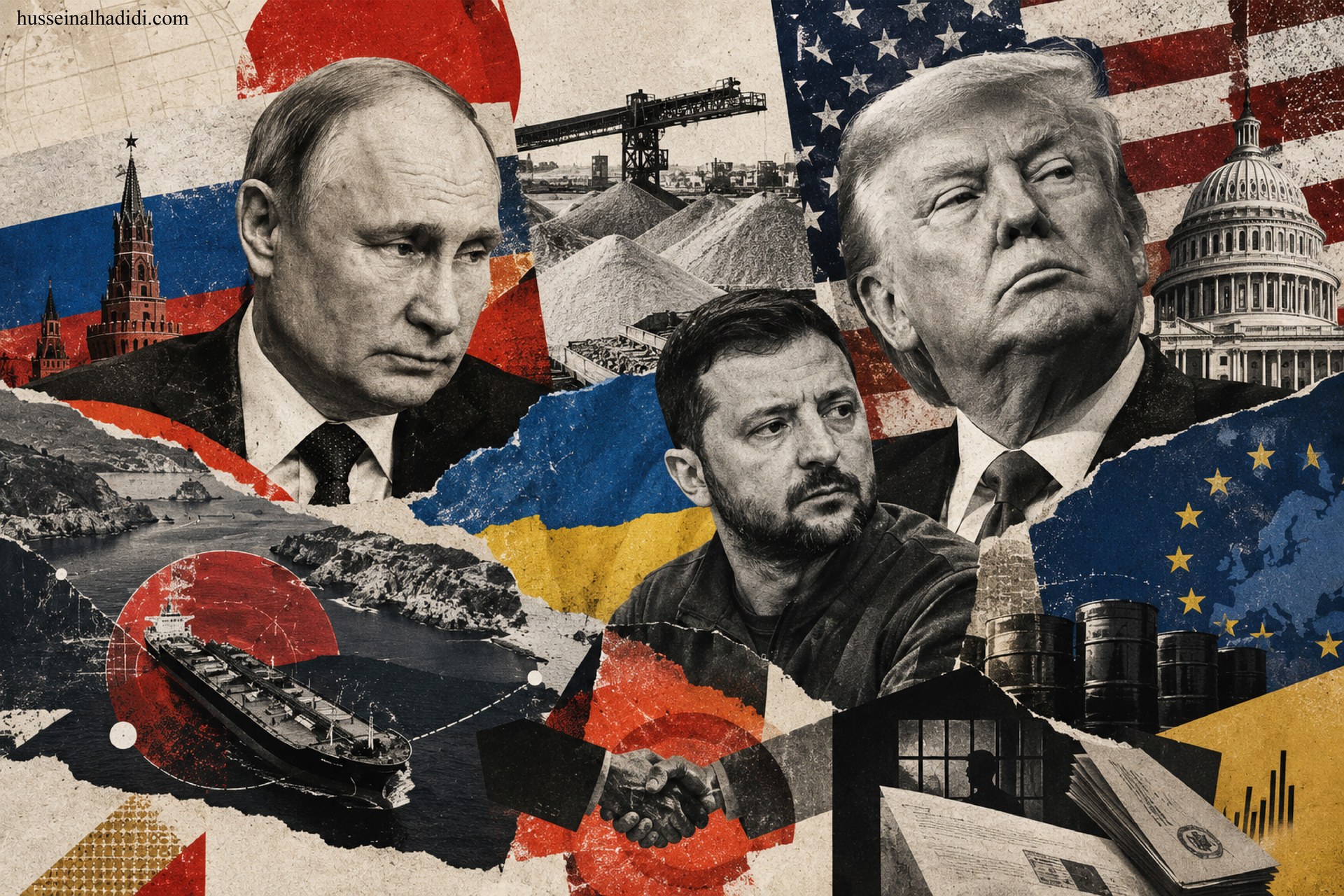
On September 5, Washington's two envoys, Steve Witkoff and Jared Kushner, passed through the gates of the Kremlin and sat with Vladimir Putin for about three hours, then left without any announced breakthrough. The surface was silence; the substance was speech. For the American delegation thanked Moscow for the release of the teacher Robert Gilman, who had spent time in its prisons since 2022, and the Russian and Ukrainian sides halted strikes on the two capitals until the conversation could be completed. Then, three days later, came a call between Trump and Putin. And on the twenty-ninth of the month, there leaked what binds these margins together into a single pattern: that John Coale, Trump's envoy to Belarus, had proposed to the president that the Minsk formula be carried over to Moscow, so that political prisoners would be released, sanctions eased, and the doors of deal-making opened; and Trump agreed to try, and the project is still in its cradle.
Thus sanctions, which were born a sword, came to be laid on the table as a currency; spent in proportion to what is paid for them.
The Minsk Laboratory: What Bore Fruit and What Did Not
Coale tested his formula in Belarus for more than a year. In December, one hundred and twenty-three prisoners walked free, among them the Nobel laureate Ales Bialiatski, and sanctions on the potash sector were eased. In March, two hundred and fifty others were released, and sanctions were lifted from the largest potash producers. In sum, the tally is about five hundred prisoners, a genuine humanitarian tally that must not be made light of; for behind every number is a family that got one of its own back.
Yet the last chapter is less dazzling. In mid-September, twenty-five prisoners were released in exchange for lifting sanctions on two companies, a figure far below what had been promised. Human rights organizations and released prisoners say the authorities arrest others to take the place of those they have freed, while Alexander Lukashenko denies that there are any political prisoners at all. Then Trump announced a large potash deal, and Lukashenko replied on the same day that the entire quantity was already under contract. As for Europe, it did not lift its sanctions, and did not allow the potash to pass through its ports. Thus the experiment appeared half a success and half a question: does the prisoner remain a price paid once, or does he become a commodity manufactured in order to be sold?
Two Wagers That Do Not Meet
Behind the project stand two logics. The logic of the White House says that trade creates mutual dependence, dependence creates shared interests, and shared interests lower tensions until peace becomes cheaper than war. And the logic of Kyiv, and with it most European capitals, says that trade is revenue, revenue is resources, and resources are the capacity to keep fighting; the Ukrainian president summed this up by saying that whoever gives Russia money through trade gives the war time.
And the realist school of international relations adds what lies between the two logics. It holds that the war has reached a hurting stalemate in which no one imposes his will, and that the loss is spread among everyone: Ukraine loses its land, its people, and its future; Russia emerges weaker and more beholden to China; Europe bears a cost it can hardly bear; and America pays in fuel and in politics. It concludes that what is missing is not the shared interest but the mediator capable of pressing both parties together, rather than one of them each time. It proposes a settlement whose outlines are: no membership in the NATO alliance, an open door to the European Union, a Ukrainian army capable of deterrence, and borders to be negotiated. Its opponents reply that this view charges the expansion of the alliance with some share of the burden of the invasion, and that sovereign states are entitled to have no veto held by their neighbor over their choices. And the difference between explaining behavior and justifying it is a difference that ought not to be lost in the din of enthusiasm.
There remains a question that rises above both camps: who guarantees that Moscow will not use the truce to mend its strength and then return? And who will persuade both parties that Washington, the largest supporter of Kyiv, is a mediator and not an adversary?
A Test That Separates the Two Hypotheses
There is a great difference between two statements: that easing sanctions may give Russia resources, which is beyond dispute; and that it will inevitably prolong the war, which requires evidence. The decisive matter is a single question: is money the binding constraint on the Russian war effort?
The available figures say that money is a constraint, but not the only one. The budget allocated to defense about 12.9 trillion rubles, roughly 155 billion dollars, yet actual spending in the first half of the year reached about 10.7 trillion, while the deficit in the first eight months exceeded 2.5% of output, against an annual target of 1.6%. The Iran war has brought an incidental gain: the price of Russian crude leapt from around forty dollars to above seventy, and the oil extraction tax doubled in April. Even so, oil and gas revenues over the eight months remain lower than they were a year earlier, because the year began from a deep trough. That is to say, the Kremlin turns in a narrow circle: spending that runs ahead of revenue, and revenue that chases after spending.
So if we suppose, as an example and not a prediction, that easing added thirty billion dollars a year, what matters is how much of it goes to the war factories, and how much the additional ruble actually buys if the true constraint is soldiers, or chips, or industrial capacity. For this reason the test is run six months after any easing: if more than half of the new revenue is consumed by the war without any tangible negotiating concession, then the Ukrainian logic is the correct one; and if it does not exceed a fifth and is accompanied by a verifiable concession, then the American logic is the correct one. Between the two lies a gray zone that behavior settles, not arithmetic. It is a falsifiable test, and its value is that it defers judgment to the facts rather than letting impression seize it.
What Does Washington Gain? And Where Does the Answer Begin?
The answer begins at the Strait of Hormuz, not at Kyiv. For the Iran war, which began in late February, has entered its seventh month. The truce that was signed in June collapsed after weeks, and on September 26 Trump rejected an Iranian seven-day plan to reopen the strait, saying that ships are passing through it and that he holds its keys, while Tehran says its new order in the strait is irreversible, and newspapers reported that the president expects a new bombing campaign after the midterm elections in November. And in the south, the Houthis have declared since July a naval blockade of Saudi ships, and have seized a strip of Yemen's Red Sea coast, and their missiles struck Riyadh this week.
In this climate, Washington gains from a thaw with Moscow at least three things. The first is barrels of oil: every barrel that returns to the market eases the shock of Hormuz, loosens Tehran's grip on its most important card, and lowers the price of gasoline before the vote; and whoever holds a long breath in the economy holds a longer patience in negotiation. The second is attention and munitions: air defenses and interceptor missiles are limited, and whoever bought them for Ukraine does not buy them for his allies in the Gulf, and the realists see that America's influence has receded because of the war in Iran, the shortage of munitions, and the growing deficit; so the legitimate question is: does Washington hold the cards that a mediator is presumed to hold? The third is that it may try to lessen the support that reports say Moscow provides to Tehran, a wager conditional on a capacity for verification that has not yet been tested.
But the calculation is not all profit. For Russia is among the greatest beneficiaries of the disruption of energy, and whoever profits from disruption cannot be relied upon to end it; so Moscow does not enter mediation as a neutral, but as a party with a stake.
The Stick and the Carrot in One Hand
And here is a paradox that does not appear in the headlines. On September 18, Trump signed a law named for the late Senator Lindsey Graham, which authorizes tariffs of up to one hundred percent on the largest buyers of Russian oil and gas, among them China and India, and imposes sanctions on the Russian leadership, the banks, and the shadow fleet of tankers. Its measures begin within thirty days, that is, around October 18, yet the president holds a waiver authority if he sees it as in the national interest.
Thus one hand holds the sword and the currency together: a law that tightens, and a waiver that loosens. And the key to the scene is this waiver; if it is used as a reward conditioned on documented steps, it becomes part of the architecture of negotiation, and if it is used as a gift without return, the law is emptied of its substance and Kyiv's fears come true.
Where Does Israel Stand?
The answer here stops at the limits of a reading of interests, not of accusation. Israel enters its elections on October 27, its prime minister facing a difficult examination; and many Israelis saw in the June truce a deal that leaves Iran standing with its missile and nuclear capabilities insufficiently addressed, and Netanyahu had reservations about it, publicly with caution and privately with unease, and afterward said that he had advised Washington to tighten the siege on Tehran, and that he doubts the possibility of a good deal with it. Analysts see that his interest diverges from Trump's on this point.
Hence it is expected, by way of estimate and not certainty, that Israel will seek three things: to link any easing for Moscow to a reduction in Russian equipment reaching Tehran; to deepen coordination with the Gulf against the Houthis and Iran; and to keep its hand on the option of escalation should an American-Iranian settlement appear that it deems incomplete. And against this reading stand considerations: Israel pays the full cost in its blood, its economy, and its home front; its security establishment does not read attrition with a single reading; and it maintains a channel of contact with Moscow that it has guarded for years. Then too, attrition benefits various parties; Tehran turns it into cards, the Houthis build their standing on it, and Moscow reaps revenue from it. So no single party alone holds the key to the exit, and every party holds a lock of its locks.
Four Possible Paths
The likeliest is that the present state continues: a war of lesser heat in Ukraine, a dialogue that covers small deals of prisoners and goods, and attrition in the Gulf beneath a ceiling that does not reach total explosion. Following it is a path of managed freeze, in which a partial ceasefire opens the door to a gradual economic normalization beginning with fertilizers, grain, and energy. Below both is a path of reversal, in which Moscow stiffens or a deal is exposed, and the law is applied in its full severity. And weakest is a comprehensive settlement in which Ukraine, Hormuz, and the Red Sea meet, because it requires the synchronization of what does not synchronize: Putin's desire, Tehran's patience, Israel's calculations, and Europe's trust.
Relief in Stages, Snapback on Breach: A Workable Exit Formula
Between trade as a reward and trade as an open window, there is a third formula, less poetic and more rigorous: easing that is phased, conditional, and reversible. It begins with what does not touch war-making capacity, such as fertilizers, grain, and energy directed to markets struck by the disruption of Hormuz, and it excludes dual-use goods and sensitive technologies. It is divided into stages, each hostage to a documented step: a ceasefire, then arrangements on defined lines, then security guarantees that Kyiv accepts. A share of the additional revenue is placed in an escrow account for the reconstruction of what was damaged, so that the money becomes part of the price of peace and not part of the price of war. This is coupled with an automatic snapback clause that restores the sanctions in full upon breach. And Europe, in whose hands are punitive instruments that Washington does not hold, undertakes the verification and takes part in the deal rather than receiving it. And on the prisoners' side, the lists are named and verified, so that release does not become a revolving door.
And there remains the paradox that governs the whole scene: that Putin does not need to win, it is enough that he not lose; and that Trump does not need to triumph in Hormuz, it is enough that he not appear defeated before November. And between two men each of whom needs only not to lose, wars live long.