On the evening of September 6, the blue screen in the eastern German state of Saxony-Anhalt lit up with one name in large letters: Alternative for Germany. It wasn't a passing win but a crack in a wall deliberately built since 1945: a Germany that isolated the far right through law and memory now watches its most hardline party lead national polls, with outright majorities looming in eastern states that even the traditional big parties never achieved.
A few hundred kilometers away, Marine Le Pen leads second-round polls ahead of France's spring election, Britain's Reform party tops consecutive national surveys, and in Italy, Giorgia Meloni presides over the longest-serving government in the Republic's history, even as a rival further to her right waits in the wings. Three countries, three different election dates, and one recurring calculation: a European center exhausted by decades of the same promises, and a voter who no longer believes them.
The question worth asking isn't "why is the far right rising?" — any analyst can answer that with a ready-made line about "migration and identity." The sharper question is: who is actually feeding this fire, and does each party realize it's stoking a blaze someone else will warm their hands by?
### Four Streams Flowing Into One River
There's no single cause explaining what's happening from Berlin to Paris to Warsaw. It's more accurate to see four separately-rooted currents whose results intersect, each unwittingly feeding the others.
The first is purely economic. European centrist governments are facing what one Europe specialist described as a version of "sophisticated state failure": political systems that hold together on paper while remaining genuinely unable to respond to the cost of living and unemployment. In Germany, voters backed the Alternative party with roughly twice the votes of the conservative chancellor's party, amid inflation and industrial stagnation. In France, the government has failed to pass a budget for two consecutive years for the first time in the Fifth Republic's history. In Britain, the 2024 election produced the lowest combined vote share for Labour and the Conservatives in over a century. The center doesn't collapse in one blow — it erodes through accumulated failures, each one reinforcing the same narrative: no one from within is capable of reform.
The second is algorithmic, and concerns the rising generation specifically. The far right no longer needs rallies and speeches to win over young people; one relentlessly-running app suffices. German academic studies have found a positive relationship between TikTok use and voting for the Alternative party among young voters, with the party and its political milieu reaching an especially large number of users on the platform. Ahead of the last German federal election, one study found that nearly three-quarters of the partisan content TikTok's and X's algorithms pushed to German users favored the hardline party — even though it was still winning a far smaller share than that at the ballot box at the time. The algorithm carries no ideology, but it rewards anger and polarization simply because they keep users on screen longer — precisely what the Top Risks 2026 report warned about when it described business models built on "addiction by design" shifting from a marketing problem into a political one.
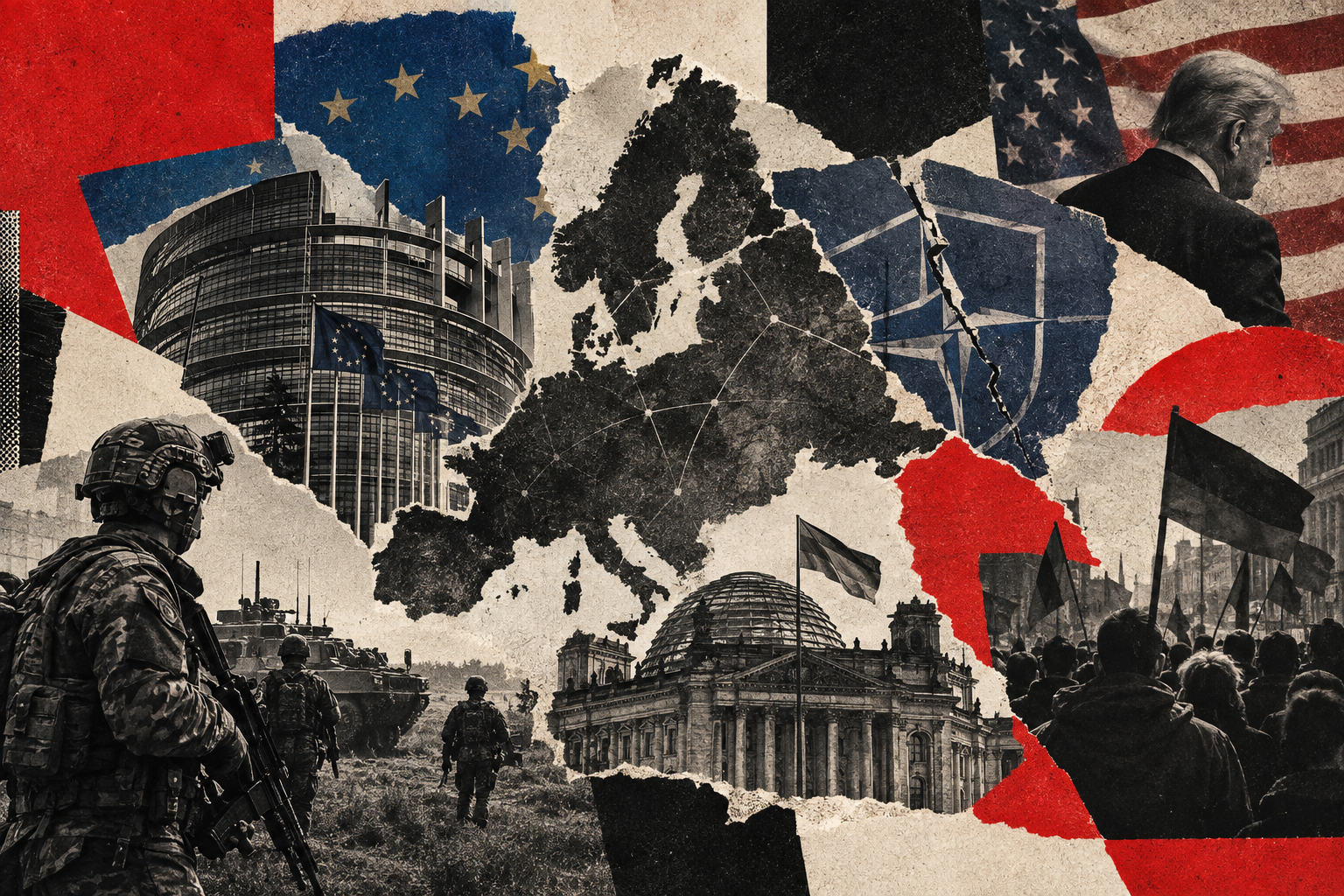
The third is Russian, and entirely deliberate. The Kremlin isn't merely watching Europe's far right rise — it's investing in it directly. Western intelligence reports describe organized Russian disinformation campaigns specifically targeting German elections to boost the Alternative party's results, alongside elections in Bulgaria, Slovenia, and Hungary. This runs alongside a broader hybrid war: drones over European airports, undersea cable sabotage, and airspace incursions in the Baltic states and Poland. The Russian logic is simple: a united, strong Europe is an obstacle to Moscow in Ukraine, while a fragmented Europe run by nationalists skeptical of the EU and NATO is the best outcome Putin could get without firing a single shot on the western front.
The fourth is American — and the most contentious, because it comes from the ally, not the adversary. The Trump administration makes no secret of preferring a fragmented Europe over a united one, and openly backs the right-wing forces capable of dismantling it from within. This doesn't mean Washington "created" Europe's far right — its roots run deeper and older than any American administration — but it does mean the international winds, instead of resisting the wave, are now pushing it. And when European voters see their historic ally across the Atlantic betting against their own government, their conviction deepens that no one — neither inside nor outside — stands with the status quo.
### A Fifth, Murkier Thread
There's a fifth current that can't be ignored, though it demands more precision than the rest: Europe's divide over Gaza.
Repeated European polls since 2023 have shown a sharp and unprecedented decline in public support for Israel across the continent, reaching its lowest recorded levels in some of Europe’s major countries. At the same time, a significant proportion of Europeans believe that the war in Gaza involves the killing of civilians and children on a massive scale. More important than the figure itself is its impact on trust in institutions. Hundreds of thousands of protesters taking to the streets of London, Berlin, and Paris were not demonstrating solely out of anger at Tel Aviv, but also out of anger at their own governments, which they saw as complicit or silent, despite their repeated claims to uphold a “rules-based international order” based on humanitarian principles.
And this anger doesn't flow in one direction. Part of it fed the radical left — as seen in Jean-Luc Mélenchon topping some French first-round polls. But another part, the more dangerous one, fed the nationalist right itself, which presents itself as the "unhypocritical" alternative to a political elite it accuses of double standards: speaking of human rights in Ukraine while staying silent on Gaza. One needn't take any position on the conflict itself to notice this structural fact: every crisis that exposes a gap between European governments' rhetoric and their actual conduct becomes further fuel for those who say the whole system is an empty facade. That's precisely what makes the Palestinian file, despite its geographic distance, a domestic factor in European politics rather than a foreign one.
### China Reaps Where It Didn't Sow
Add to all this a factor less present in daily discourse but no less weighty: China is flooding European markets with its industrial export surplus after failing to absorb it domestically, at a time when Europe is already falling behind in the race for clean technology, batteries, and electric vehicles, which Beijing now dominates by an overwhelming margin. The result is twofold: declining competitiveness for European industry on one hand, and imported inflation on the other, adding to the energy and food bills ordinary European voters pay. When a German or French factory worker loses his job to a cheaper Chinese competitor, the last thing on his mind is an economic theory about "global trade restructuring" — what's on his mind is who's promising to protect him, and the more convincing-sounding promise is usually the nationalist's, not the technocrat's.
### When Anger Turns Into Artillery
There's a sixth dimension that doesn't show up directly at the ballot box but is growing in defense budgets: Europe isn't just voting out of anger — it's starting to arm itself out of fear.
The scene that changed the calculus took place on February 28, 2025, when Ukraine's president found himself publicly berated by Trump and his vice president before the world's cameras in the Oval Office. The moment wasn't only about Ukraine; it was a message to every European capital: the ally on whom the security umbrella had rested since 1945 could publicly abandon you, and could humiliate you while you asked for its protection. European leaders themselves read the message with that clarity — France's prime minister went so far as to describe the scene as a display of "brutality" aimed at humiliating Ukraine into accepting Moscow's terms. And when Zelensky returned to Washington months later, he didn't go alone — he brought Europe's leaders with him, fearing a repeat of the scene, itself an implicit admission that trust had broken.
The result showed up quickly in opinion polls: by November 2025, only about a sixth of surveyed Europeans still saw the United States as an ally, down sharply from just months earlier, while the share viewing it as a "rival" or "adversary" rose to nearly a third in Germany, France, and Spain. For the first time since the end of the Cold War, a growing segment of European public opinion no longer sees Washington as a savior, but as a party whose promises can no longer be trusted.
This translated into real budget figures. Germany approved a rearmament plan worth more than €80 billion for next year alone, but the striking part is that more than nine-tenths of that sum will go to European industry rather than American — a reversal of a full decade in which Germany was among the biggest customers of American weapons. The plan includes new naval frigates, a major batch of Eurofighter jets, and expanded tank and armored-vehicle production programs. France, meanwhile, is emerging from a quiet crisis: its Rafale fighter fleet had shrunk in recent years to its lowest level since the end of the Cold War, after Paris sold dozens of used aircraft to Greece and Croatia and donated a number of Mirage jets to Ukraine — to the point that a former defense minister acknowledged a shortfall of up to thirty aircraft against operational commitments. Today, Paris is working to rebuild that fleet, amid an open dispute with Berlin over production shares in the joint European sixth-generation fighter program.
This is precisely what makes the moment dangerous rather than reassuring: a continent rearming amid sharp internal political division, while a Russian hybrid war — drones over airports, cable sabotage, airspace incursions — is genuinely escalating on its eastern border, according to the Top Risks 2026 report, which warned that NATO itself, after years of absorbing provocations, has for the first time begun leaning toward response rather than silence. When a hastily-rebuilt military meets an alliance losing faith in its traditional leader, meets an adversary betting that no one will respond to its provocations, the margin of error separating an "incident" from a "war" narrows.
But this shouldn't be read as inevitable either. There's a paradox noted by researchers specializing in European affairs worth pausing on: those who have entirely lost trust in America and now regard it as an "adversary" aren't necessarily the most enthusiastic about footing the bill for European defense independence — broad segments of them are the very voters for far-right parties already skeptical of military spending and of the European Union itself. Those most convinced of the need to rearm remain, by contrast, those who still believe NATO can be salvaged rather than replaced. In other words: anger at Washington hasn't automatically translated into a European consensus on how to respond to it — and this very fragmentation may be as much a brake on escalation as it is a danger in itself. A Europe that is armed but undecided may be more dangerous than a weak Europe, yet it's also less capable of initiating a war on its own.
### Two Objections Worth Addressing
The first objection: Isn't the far right's rise an inevitable, unstoppable fate? The answer is no. Hungary itself ousted Viktor Orbán last April after 16 years in power, brought down by accumulated corruption and economic mismanagement — meaning the very same causes fueling the far right's rise are capable of bringing it down once it, too, fails in office. The far right isn't invincible; it's simply more persuasive than its alternative right now.
The second objection: Isn't it an exaggeration to speak of an "American bet" against a united Europe? This objection is partly reasonable — Washington didn't create Europe's crisis, which runs deeper than any single American foreign policy. But the difference between a previous administration that regarded a united Europe as a strategic asset, and a current one that sees an opportunity in its fragmentation, isn't a marginal difference — it's a difference in the direction of the wind itself.
### Three Milestones: Two Already Happened, One Still Ahead
In May, Britain's local elections gave the first answer: Reform didn't just stay atop the polls — it translated that into reality, its best-ever result at roughly 28% of the nationally-equivalent vote, and direct control of more than a dozen local councils, while Labour continued its slide into third place behind the Conservatives. The question was no longer "can Reform's polling lead translate into seats?" — the answer is now a documented yes, and the real question has become the timing of the next general election.
In Germany, the wave didn't stop at Saxony-Anhalt. Just two weeks later, on September 20, the northern state of Mecklenburg-Vorpommern voted, and the Alternative party won first place with more than 38% — more than double its result five years earlier — making the hardline party the largest bloc in a third German state parliament within less than a decade. More alarming than the win itself: the Christian Democratic Union, the historic pillar of the "firewall" isolating the far right for decades, was wiped out of the state parliament entirely after falling below the 5% threshold there for the first time in its history. When the party historically tasked with maintaining the firewall disappears from the picture altogether, the question of who will maintain it instead becomes one without a ready answer — even though the Social Democrats can, for now, still form a governing coalition with the Left and the Greens by a slim majority.
The biggest test still lies ahead: France's presidential election next spring, where the world may see, for the first time, a French prime minister from Le Pen's party, ending decades of the "anti-fascist firewall" that has held across Europe since the end of World War II. And as eyes turn to Paris, the question already raised by the German and British results remains unanswered: is this firewall still standing anywhere on the continent at all, or is it now falling state by state, before it finally collapses in the continent's largest capital?
At none of these milestones did the far right entirely create its own opportunity. It was created by a stagnant economy, an algorithm indifferent to the difference between truth and anger, an eastern neighbor investing in chaos, a western ally betting on fragmentation, and a rift over a distant war exposing a nearby hypocrisy. Each of these actors believes it's serving its own interest — Moscow wants a weaker NATO, Washington wants a more pliant Europe, the algorithm just wants a user who won't close the app — yet all of them, without coordination, are pouring into one river whose mouth empties into a single ballot box.
It's said of European history that the weakest republics didn't fall through sudden coups, but through slow erosion that made their eventual collapse, when it finally came, look like the only option left. The continent today isn't rewriting that story word for word, but it's borrowing its rhythm: not one great fire, but scattered embers, each looking innocent on its own, together sufficient to set an entire continent ablaze. And the final irony is that whoever lit each ember separately — whether Putin in Moscow, an algorithm in California, or an angry farmer in Saxony — is rarely the one who ends up sitting in the seat of power that his own fire lit.