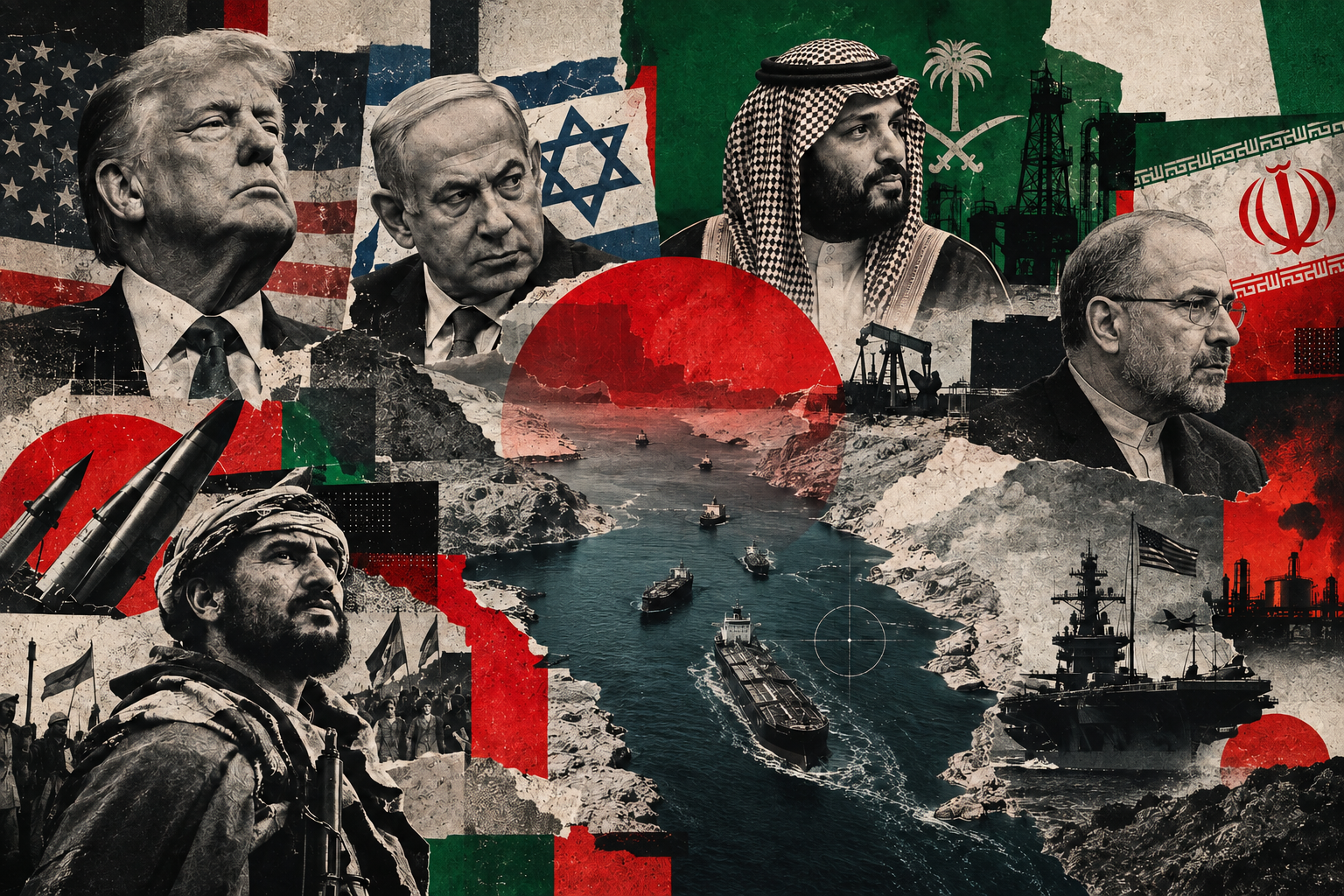
On the morning of 19 September, a column of black smoke rose from the fuel depot near King Khalid International Airport in Riyadh. The Houthis announced that they had struck "sensitive sites" in the Saudi capital and Aramco facilities in Yanbu. The next day, Mohsen Rezaei, secretary of Iran's Supreme National Security Council, said that Tehran had delivered to Washington, through Qatari mediation, seven conditions for opening any negotiations, and that it stood ready for a "decisive war" if they were rejected.
Two events, one headline. The first raises the cost of the war for those who did not start it. The second addresses Washington in the language of a victor. Between them stands the one party that needs to fire no shot in order to profit: Israel.
A War Whose Ammunition Lands on the Neighbors
The war began on 28 February with joint American-Israeli strikes that killed Supreme Leader Ali Khamenei and a large number of the regime's commanders. The expectation was that Iran's response would be aimed at those who had started it. The numbers said otherwise. In the first weeks of the war, Iran fired more than 5,300 missiles and drones, of which only 930 reached Israel, or 17%. The rest, 83%, went to the Gulf states. The UAE was the most heavily hit, with more than 2,000 missiles and drones, followed by Kuwait, then Saudi Arabia, Bahrain and Qatar.
The reason is that the Gulf hosts American bases, its economy is made of glass, and a strike on a refinery, port or airport is heard in the energy markets before it is heard in the capitals. Israel, by contrast, shelters under the densest air-defense network in the region. Tehran chose to hurt where the world feels pain, and its neighbors became the shortest road to Washington. One question was left unanswered in its calculations: who pays for this war, and who collects on it?
The Chain of Costs
Every great war has a rule that no one announces: each party tries to pay for it in someone else's currency. What is happening today is a textbook case. Iran spends its ammunition on Gulf soil, so the Gulf pays with its oil, its ports and its airports. The American voter pays at the fuel pump, and the White House tries to send the bill back to Tehran through bombing. One link in this chain pays almost nothing, and converts what others pay into land, bases and influence.
Three old concepts explain this scene better than any conspiracy theory. The first is buck-passing: powers leave the burden of confrontation to others for as long as they can. Washington sells and does not fight, Riyadh waits for Washington, and Tehran pushes the Houthis and the Iraqi factions to the front. The second is mutual attrition: the state that stays out of the fire and lets its rivals bleed one another emerges stronger without winning. It is enough for it to sit skillfully on the edge. The third is the balance of threat: states do not ally against the strongest power, but against the one most dangerous to them, the nearest and the most aggressive. A Gulf capital whose rooftops have been hit by drones will not weigh the Israeli danger on the scale of the occupation in Palestine. It will weigh it on the scale of what burned there this week.
Hence the irony that no one in Tehran wants to hear: the most successful recruiter of the Gulf into the Israeli-Emirati axis is neither American pressure nor Israeli enticement, but Iranian conduct itself. One who shells his neighbor should not be surprised when the neighbor calls on the man who sells the umbrella.
Negotiating by Fire
The war paused with a truce in April, brokered by Pakistan. The truce then collapsed, and in July the American naval blockade of Iranian ports was reimposed. Since then Tehran has operated by a clear logic: it holds Hormuz directly and Bab el-Mandeb by proxy. Some 20% of the world's oil trade used to pass through Hormuz, and about 7% through Bab el-Mandeb.
On 20 July the Houthis declared a blockade on Saudi ports and ships, and Saudi tankers off Yanbu came under their missiles. Then drones launched by Iraqi factions shut down the pipeline that had been carrying more than four million barrels a day to the Red Sea. The Houthis advanced along the western coast until they controlled most of it, and on 11 September they reached the island of Perim in the heart of the strait. More than 112,000 Yemenis have been displaced, and the price of a barrel of oil has passed $100.
Note where the missiles are pointed. Since the blockade was declared, the Houthis' strikes have concentrated on Saudi Arabia, not on an American aircraft carrier or an Israeli port. The message needs no translator. The real missile aimed at Washington is the price of gasoline at American pumps, and the shortest road from Tehran to the president's desk runs through the fuel pump.
Then come the conditions: an end to the war on all fronts, foremost among them Lebanon; the release of frozen funds; the lifting of the naval blockade; an end to American interference in Iranian affairs and to cooperation with "the enemies of the revolution"; and a halt to any attack on Iranian territory. Mohammad Bagher Ghalibaf declares that Hormuz will stay closed until Washington fulfills its commitments.
Tehran's motive is understandable. It has lost a large part of its axis, and the Americans are gradually restoring the flow of oil through Hormuz, so it searches for a card to compensate for what has slipped from its hand. The flaw lies in the ceiling, not the motive. There is a difference between a negotiator who raises his price in order to sit down and one who raises it so that no one sits at all. Conditions that read in Washington like articles of surrender, addressed to a president who knows that any concession before the election will be written up in his opponents' campaign as defeat, do not open a door. They set a lock.
A President With Nothing to Lose
On 3 November, Americans vote in midterm elections that are heading, by most indicators, toward punishing the Republicans. The war is unpopular, the price of a gallon has passed $4 at a level unprecedented for this season, and discontent has begun within the Republican base itself. Trump has tied the end of the war to the period after the elections, as if to say that Tehran's cards, timed to the voter's clock, lose their value the next day.
Here lies the paradox. The Houthis appear to be timing their strikes to the American election in order to raise the cost to Trump, but the same clock may turn against them. A politician who suffers from fuel prices before the vote may not care about them after it. A president who has lost the House will no longer fear the anger of a constituency, or a legislator seeking reelection. He has more than once threatened a strike aimed at the head of the Iranian regime, and reports speak of private warnings from his senior advisers, including his vice president and secretary of state, that the conflict may extend to the end of his term. None of this makes open war inevitable, but it means that the heaviest constraint on the decision to escalate, fear of the ballot box, falls away.
A week earlier, on 27 October, Israelis go to their own polls. Netanyahu contests the election with a weary coalition against challengers such as Gadi Eisenkot and the Bennett-Lapid alliance. Two elections bracket a single phase, and in such a campaign the external threat remains the most useful headline for whoever is in power.
The Winner Who Doesn't Fire
Israel does not need to defeat Iran or the Houthis. It needs them to remain where they are: strong enough to keep the fire burning, too weak to overturn the table. The enemy who neither falls nor triumphs is the best enemy for one who wants to be free for another arena.
The tally has begun to take shape. In the north, Israeli forces have occupied southern Lebanon since March. At sea, on 26 December 2025, Israel recognized a breakaway territory in the Horn of Africa overlooking the Gulf of Aden, the first state to do so. Reports speak of an Israeli intelligence presence on that shore, and of joint activity with the UAE on islands in the Gulf of Aden. That is, Israel is building, on the far side of Bab el-Mandeb, a foothold in the corridor contested by the Houthis and the Saudis.
And in Palestine the map widens in silence. Rights groups estimate that Israel now controls about 64% of Gaza, against the 53% stipulated by the October ceasefire. Its government approved 34 new settlements in the West Bank in March, three of which were inaugurated in early September, alongside confiscation orders reaching areas classified as "A" in Jenin. Israeli reports indicate that Washington blocked a wider ground operation in Gaza, so the government chose creeping annexation instead.
When all eyes turn to two straits, oil fields and airports, an order to confiscate land in Jenin becomes a footnote. That is the meaning of going it alone in Palestine: not one big blow, but thousands of small bites in a time when everyone is preoccupied.
Yet the calculation is not without cost. On 8 September, twelve countries, including Britain, France and Canada, announced restrictions on settlement goods, and Israel responded by giving Britain 30 days to close its consulate in East Jerusalem. The window, then, is not open-ended, and that makes Israel's haste understandable.
Riyadh at the Crossroads
The Houthi advance on the coast was not a purely Iranian decision. Riyadh sees in the Horn of Africa, the islands of the Gulf of Aden and southern Yemen a ring tightening around it, where Israeli and Emirati interests intersect. In response it has built a parallel axis that includes Turkey, Pakistan, Qatar and Egypt and excludes Abu Dhabi, and on 7 August it signed a mutual defense agreement with Ankara and Islamabad. The Houthis read the scene from the opposite angle: whoever holds the western coast today prevents an Israeli or Emirati base from overlooking the strait tomorrow. Their lunge served Tehran, but it also came as a preemptive move against the internationalization of their arena.
On the ground, the picture looks harsh for Riyadh. Reports say that as many as 80% of the fighters listed in the Saudi-backed forces are names on payrolls, and speak of Houthi penetration of coalition communications and a shortage of interceptor missiles. Washington watches from a spectator's seat, despite its preliminary approval of a sale of F-35 fighters to Riyadh. The kingdom has asked France, Britain, Pakistan and Egypt for air-defense assistance. Reports speak of undeclared intelligence channels with Israel passing through the American Central Command, and of a military meeting in Germany that brought together Israeli, Saudi and Emirati commanders.
Here the fatal attraction arises. Those who possess the intelligence, the air umbrella and the field experience in southern Yemen are Israel and the UAE, and voices in Washington openly urge Riyadh toward normalization with Israel and reconciliation with Abu Dhabi. Saudi officials reply that help will not buy normalization, and that its road runs through an irreversible path to a Palestinian state. But wars do not respect statements. The likelier outcome is not a signing ceremony but a gradual slide: information passed, systems deployed, coordination growing, until Riyadh finds itself in an alliance without a flag. Normalization without a signature.
And suppose the alliance forms. Would it prevail? Saudi Arabia has tried air bombardment in Yemen since 2015. Washington tried it in a campaign that ended in May 2025 with a declaration of victory, and the Houthis today have a wider reach than before. The likelier result is that the trilateral alliance will not end the war but extend it. It will turn Yemen from a civil war into a regional war of attrition, in which Riyadh and Abu Dhabi pay for intercepting each drone many times over its price, Iran pays a paltry sum out of its proxy's stockpile, and Israel reaps an incalculable gain: everyone is preoccupied with one another.
The Fuse in the Hands of the One Who Lit It
Whoever reads the Houthis as an arm moved by a switch is mistaken. The group has its revenues from the ports, its tribal base, and its own calculations in choosing its timing and its targets. That is why the logic of Hormuz recurs in the Red Sea. Iran proclaims its enmity to Israel and spends its ammunition on its neighbors, and the Houthis announce that their weapons will touch only Saudi ships. A slogan raised against the distant enemy, a weapon expended on the near rival.
And the group has a precedent. In May 2025 it reached an independent understanding with Washington that halted its attacks on American ships, and afterward it continued targeting Israel until the Gaza front calmed. Reports say that only days ago it informed Washington, via Muscat, that it would not target Israeli ships and that its strikes would be limited to Saudi Arabia. It is plainly seeking to convert its gains on the ground into political recognition, and to become an indispensable party to any arrangement for Red Sea security.
What if the group moved from being an Iranian arm to being a maritime security contractor for the West? The possibility does not seem remote. Washington is weary. It wants cheaper oil and a quiet corridor before it turns to other matters, and it may find it easier to deal with an authority that actually holds the coast than to bet on an ally that does not hold its own ground. Some see the group as increasingly integrated into the Iranian project, and there is merit in that. But a group that places its survival above every slogan may sell the same card to whoever pays more. Then the one who lit the fuse will realize that the fire may turn in his hand, and Tehran will lose its most precious asset at the moment it needs it most.
The Strongest Objection
Three objections stand first against this reading. The first is that Israel does not want endless attrition. Estimates in the war's first weeks held that its goal was to topple the entire Iranian regime, and that what worries it is a US-Iran agreement that keeps Tehran at the table without defeat. Israel was struck by 930 missiles and drones, and it knows that an Iran left to recover returns with heavier weapons. The objection is sound as to intent, but the winner does not need intent. It is enough that the structure favors him. Israel profits from every outcome but two: an agreement that leaves Iran intact and lifts the blockade, or a decisive collapse that it cannot achieve alone. In between, each additional day of fire gives it more room. And if it wants a decisive outcome, it will come after 3 November, in the same window.
The second is that Trump will not become unconstrained. The House has passed three resolutions to restrict his war powers, most recently on 15 September by 220 votes to 204, with seven Republicans joining. And a House led by Democrats after November, if that happens, holds the budget and the power of subpoena, so the constraint does not vanish but changes shape. That is true, but true only later. The resolutions are largely symbolic because a veto looms, and the current Congress remains in place until early January, before the new House is sworn in. Those weeks lie between the president's fear of the voter and the new Congress's grip on the budget, and they are the most dangerous item on the calendar.
The third is that the Houthis are no puppet, and that Riyadh helped light the fuse when, in July, the runway at Sanaa airport was struck to prevent an Iranian plane from landing, a strike the Houthis attributed to Riyadh, and that its coalition on the ground is hollow. All of this is true, which is why Iran alone does not bear the burden of the Yemeni arena. But even an independent Houthi movement reads the opportunity that Iran's war offers it, and even a mistaken Riyadh pays more than the measure of its error.
One last possibility remains: that Trump prefers a deal before the election. He has extended his deadline more than once, said he is in no hurry, and fears the price of fuel. This possibility exists, which is why what follows is presented not as destiny but as the likeliest course.
The Road to the Next Confrontation
The likeliest scenario passes through two stations. Before 3 November, a managed stalemate prevails. Tehran keeps its ceiling high, the Houthis keep nibbling at the coast and eye Marib and the oil-rich east, and Qatari, Pakistani and Omani mediation goes round in a fruitless circle.
After 3 November, a window of danger opens. Trump is freed from electoral calculations, and the current Congress stays in place until early January. Options are put on the table for striking Iran's oil and military infrastructure and the Houthis' ports and sources of armament. The weight of the Yemeni front may fall on non-Americans, for Trump has never seemed keen on a long war with the Houthis. The response will come, as always, from the weakest flank: oil installations, airports and ports in the Gulf. Then this alliance moves from the shadows into the open, and the war shifts from a confrontation between Iran and America into an open quagmire around the Red Sea. In its shade Israel accomplishes in the West Bank and Gaza what it could not accomplish in a time of attention.
And if all this dust has a purpose, the likeliest is a Yemen without unity. It requires no operations room. It is enough that events accumulate one after another. It would not be surprising if the path ended in a map resembling the one before 22 May 1990: a north held by the Houthis in Sanaa and along the Red Sea coast, and a south overlooking the Gulf of Aden, guarded by the UAE and leaned upon by Israel to secure the southern flank of the strait. In such a map the Houthis find practical recognition of their fait accompli, even if it comes through an understanding with Washington rather than Riyadh. Abu Dhabi and Tel Aviv find a maritime belt, and Riyadh loses what it has defended since 2015: a united Yemen on its southern border. Riyadh wants Yemen united. Should partition come, it would be the line at which any alliance stitched together by fear between Riyadh, Abu Dhabi and Tel Aviv snaps.
One exception remains: that a deal precedes the election. Trump wants cheaper fuel, Tehran knows the cost of the decisive war it brandishes, and the mediators are moving. But everything in the two sides' hands today says that time works against the deal, not with it.
Signposts
Five signposts reveal the direction before official statements announce it. On 27 October, the Israeli election should be read from one angle: does a more hard-line coalition return, accelerating annexation and preparation for another round, or does a government emerge inclined toward an understanding with Washington? On 3 November, the number of seats matters less than Trump's first statement on Iran the next morning, whether it speaks the language of a deal or of a strike, and the fate of the war-restriction resolutions in the outgoing Congress. At Marib, if it falls, the Houthis become masters of Yemen's oil- and gas-rich east, and talk of partition moves from forecast to arrangement. At the Saudi pipeline, if it reopens and resumes carrying millions of barrels, Riyadh has recovered its bypass card. If it stays shut while the barrel stays above $100, the pressure on Washington doubles. And on the African shore of the strait, if reports of an Israeli-Emirati presence turn into an announced base or recognition by a second state, Bab el-Mandeb has entered the phase of internationalization. The Houthi leader has already warned that any Israeli presence there will become a target.
How the Fire Is Put Out
The first thing that puts it out is to pull the fuse of the Houthis from Iran's hand, and that is settled not in Sanaa but in Tehran. No other party holds over them what Tehran holds, though its influence is not absolute. The road to Bab el-Mandeb runs through Hormuz: a deal that opens the strait, eases the blockade and gradually releases frozen funds, in return for comprehensive navigation guarantees extending to the Red Sea.
Tehran must separate what it needs from what it wants. It needs the lifting of the blockade and its funds. It wants terms that save face. Whoever sits at the table demanding everything leaves with nothing. The way out is a sequence of reciprocal, simultaneous steps in place of preconditions.
The Gulf must negotiate with Iran directly, rather than remain an arena in which the war is run by proxy. Some experts hold that the solution will come not from Washington but from a Gulf-Iranian understanding. And the one on whom 83% of the missiles fell has more right to a seat at the table than anyone else.
Riyadh must not pay the price of fear in the currency of Palestine. Turning to Israel for rescue ends in normalization on Israel's terms and in its timing, and the parallel axis with Ankara, Islamabad, Cairo and Doha, for all its slowness and shortcomings, is safer than handing one's security to someone who profits from one's loss. In Yemen, a political settlement is needed that brings the government and the Houthis to a roadmap covering Hodeidah, Sanaa airport and salaries, and that blocks a partition imposed by fait accompli. This settlement must precede any separate Houthi-American understanding. Otherwise Riyadh will find itself negotiating over what was sold before it reached the table, for the Houthis' demand for political recognition can be neither extracted by arms nor crushed by them.
The Arabs must raise the cost of going it alone in Palestine. That requires that an irreversible path to a Palestinian state be not merely the price of open cooperation but a fixed condition, and that they act alongside the European states that have begun restricting settlement goods. The window Israel is exploiting is not open forever.
Washington must acknowledge that Yemen is not a separate file. It needs a special envoy for Yemen, an open channel to Tehran, and a return to an idea everyone has forgotten: that a war is not ended by bombing alone.
In Arab lore there is a war that began over a race between two horses, consumed decades of two tribes' lives, and left them nothing but stories. The region today rewrites the tale with costlier instruments: drones in place of spears, straits in place of wells. But the rule has not changed. The one who lights the fire is not necessarily the one who warms his hands at it.