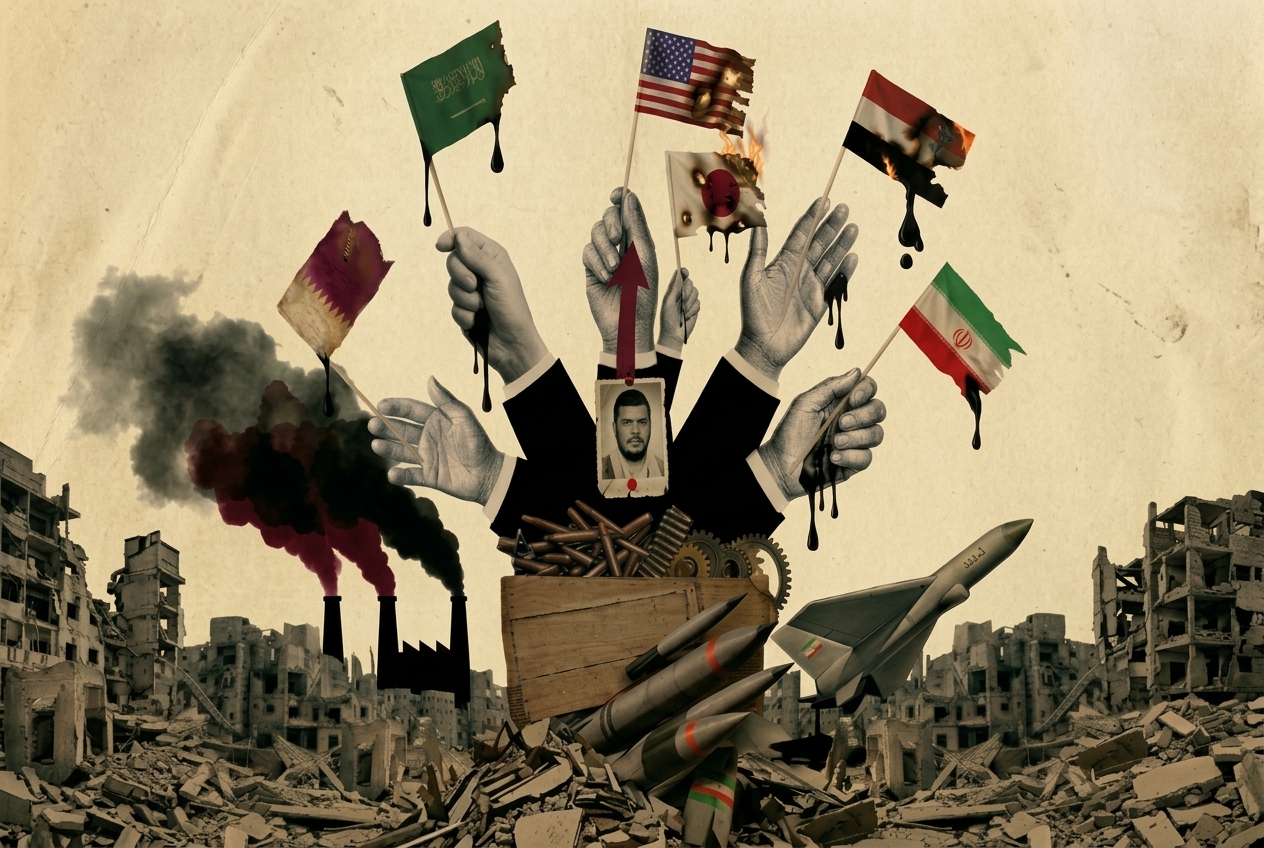
On any evening in September, all one has to do is look at the oil price screen to read the map of the war in the southern Arabian Peninsula better than any military statement. Brent crude, the global benchmark for oil pricing, was trading at around $72 a barrel before the American-Israeli war on Iran broke out in February. Today, it is approaching $108 after breaking through the $100 mark for the first time since July. The difference between the two figures is not a technical detail in a market bulletin. It is the literal translation of every Houthi missile that struck a Saudi facility, every pipeline that stopped operating, and every ship that redrew its route away from the Strait of Hormuz.
In recent weeks, the Houthis have regained momentum in their attacks on Saudi Arabia’s oil infrastructure after the front had been almost dormant since the 2022 truce. They struck the Saudi East-West pipeline, the artery through which Riyadh had been transporting around 4 million barrels a day, equivalent to nearly 4% of global oil supplies, as an alternative to the already restricted Strait of Hormuz. The result was a partial disruption of the pipeline for weeks, a rise in attacks on ships and facilities in Jazan, Abha, and Khamis Mushait, and the Houthi takeover of the Greater and Lesser Hanish Islands, strengthening their grip over one of the Red Sea’s most important gateways. The immediate result of all this was that Gulf oil exports fell in August to roughly half their pre-war levels, according to International Energy Agency estimates. Gasoline prices at American fuel stations surpassed $4.15 a gallon, while diesel prices exceeded $6 for the first time in recorded history.
Turning the Inflation Figure into a Political Pressure Tool
To understand why all of this matters to someone who has nothing to do with oil markets, it is enough to follow a single figure published every month by the US Bureau of Labor Statistics: the Consumer Price Index. This index measures a complete basket of goods and services purchased by the average consumer, from rent and airline tickets to a loaf of bread. When calculated using all of its components, it is referred to as the “headline index.” Economists and central banks, however, often look at another version that specifically excludes food and energy because prices for those two categories fluctuate sharply due to temporary seasonal or geopolitical factors, which can distort the broader picture of long-term price trends. This version is known as the “core index.”
The figures released for August summarize the problem precisely: the headline index recorded an annual increase of 3.4%, while the core index rose by only 2.4%. In other words, almost the entire gap between the two figures came from energy, whose prices rose by more than 16% over a single year, while gasoline prices alone increased by more than 27%. In other words, the American economy, excluding the fuel bill, is not far from the stability target sought by the central bank. With the fuel bill included, however, the picture is completely different, and it is this picture that forces monetary policymakers to act.
Here lies the real danger that concerns central banks more than the figure itself: energy costs may remain elevated long enough for their impact to spill into production inputs, then into final prices, and then into wage demands, transforming what began as a temporary shock into a self-reinforcing cycle. This is precisely what all major central banks are trying to avoid this autumn, and it explains the striking synchronization in their moves.
A World Raising Interest Rates at Once
The US Federal Reserve stands on the eve of these lines before its scheduled September 16 meeting, where markets expect the first interest rate increase since 2023, from a range of 3.5% to 3.75%, to a higher range that could approach 4%. The yield on the 10-year US Treasury note is itself approaching 5%, a level that has begun to worry investors that markets are demanding greater compensation for the combined risks of inflation and fiscal deficits, while the major US indexes have declined in recent sessions under the weight of these expectations.
On the other side of the world, the Bank of Japan raised its interest rate last June to 1%, its highest level in decades. The market is awaiting another increase at its scheduled September 17 and 18 meeting, which could take the rate to 1.25%. The European Central Bank, for its part, moved ahead of everyone with its increase. This synchronization is not a coincidence of timing. It is the logical result of a single energy shock hitting different economies at the same time, forcing even emerging economies that do not necessarily suffer from comparable inflation to raise their own interest rates simply to defend their currencies against a dollar that becomes more attractive as its returns rise.
Even gold, traditionally expected to be the natural safe haven in times of war, has found itself caught in a striking paradox this year. It reached a historic peak above $5,500 an ounce last January as the war on Iran intensified, then fell by nearly one-fifth from that level to settle around $4,300 at the beginning of September. This happened precisely because the same war that was expected to drive gold higher is also fueling the inflation that keeps interest rates high, and higher interest rates reduce the appeal of a non-yielding asset such as gold. Gold, as is well known, needs the war to end in order to rise, not to escalate.
Who Benefits from the Continued Conflagration?
This is precisely where war turns from a humanitarian and economic catastrophe for the region into a profitable business model for another party geographically far removed from it. Washington, contrary to what its official rhetoric about “regional stability” might suggest, has an objective interest in maintaining a calculated and escalating state of hostility between the Gulf states and Iran, and between Saudi Arabia and Yemen. Permanent conflict without resolution keeps the Gulf states as permanent customers for American weapons in a prolonged struggle where no amount of purchases is sufficient to settle the battle, while keeping the region’s investment environment closed and unstable instead of opening it to genuine economic diversification. A war that never ends is commercially better than a war that does, and this is a cold commercial logic that has nothing to do with the interests of any actual regional party, whether Saudi, Yemeni, or Iranian.
The irony is that closing this file is neither unprecedented nor an untested idea. Riyadh has dealt politically with the Houthis in Yemen at earlier stages of its history, confirming that there is no eternal enmity and no eternal alliance in this region, and that interests can reconcile whenever political will exists. A settlement of this kind is not technically complicated: an actual truce that stops the launch of drones and missiles toward Saudi territory and oil tankers near Bab el-Mandeb, in exchange for releasing oil revenues to restart the economic machinery in Sanaa, alongside a parallel understanding between the Gulf states and Iran not to engage militarily in any hostile acts and not to participate in mutual economic blockades, thereby closing the door to the use of gray zones such as Iraq or Yemen as tools of mutual pressure. This is not an imaginary equation. Riyadh and Tehran had in fact been moving toward understandings of this kind before recent developments swept them away.
But closing these fronts is not a demand without adversaries. Any genuine normalization between the Gulf and Iran, and any stable peace between Saudi Arabia and Yemen, represents a direct threat to the calculations of a third party that shares no borders with either side, namely Israel. The continuation of chaos in southern Yemen and around Bab el-Mandeb gives Tel Aviv strategic room to position itself around the Horn of Africa and the Somali coast, while the Houthis in the north remain a ready-made threat that justifies continued military engagement in the region. As for the Gulf states, which are now being pushed toward a closed security model built around fortified infrastructure similar to its counterparts in Israel, this portrays Saudi Arabia as a state that feels alienated from its surroundings and permanently threatened within them.
A Media Campaign Running Parallel to the Military Battle
The struggle over who has the right to define the “best option” for the Gulf states is not taking place only on the battlefields. It is also taking place in newsrooms. Part of the American circles associated with the pro-Israel camp, with researcher Michael Rubin among its prominent voices, has repeatedly promoted escalatory scenarios against Riyadh, ranging from hints at domestic political change to pressure for deeper military involvement in Yemen without genuine coalition backing. According to this reading, the objective of this line is to push Saudi Arabia to abandon its influence in southern Yemen, weaken its involvement in Horn of Africa affairs, and obstruct its support for the Sudanese army, which these circles view as a “strategic loss” for them specifically because it constrains Israel’s room for maneuver in that geography.
What is striking is that part of the Western press coverage of this issue, in agencies such as Reuters and networks such as CNN, has presented an approach portraying all of the options available to Riyadh as “bad options,” including the option of a political understanding with the Houthis. This approach classifies “peace” as a bad option not because it is practically impossible or not beneficial to Saudi Arabia, but simply because it conflicts with American and Israeli priorities that have no direct connection to Saudi or Yemeni interests. This is precisely where the Arab reader should approach any news coverage of this issue with a critical eye: who benefits from portraying “peace” as an unrealistic option?
Yemen and the Gulf Are No Exception
Anyone who wants to understand where a war that is not closed politically can end up has only to look at Ukraine. Last July, the European Union adopted its 21st package of sanctions on Russia, the broadest of its kind in four years in terms of the number of targeted entities and individuals. It covered the energy, financial, and cryptocurrency sectors together, while freezing the mechanism for adjusting the cap on Russian oil prices until mid-2027. The official result announced by Brussels was that Russian oil and gas revenues had fallen by nearly 80% since the beginning of the war, that the Russian economy contracted slightly in the first quarter of this year, with growth expectations not exceeding 1.3%, and that roughly two-thirds of the liquid assets in Russia’s sovereign wealth fund had already been depleted.
Looking Ahead to the Next Scenario
All available indicators today point to the US Federal Reserve proceeding with an interest rate increase tomorrow, September 16, and the Bank of Japan following suit within days, continuing a global wave of monetary tightening whose real source is not excess growth but the failure to resolve a political crisis in the Gulf and Eastern Europe. As long as the Strait of Hormuz remains restricted and attacks on Saudi infrastructure continue, oil prices will remain above the $100 level, with a real possibility of testing even higher levels if the scope of targeting expands to major export ports rather than alternative pipelines alone. This will keep global inflation “sticky” at levels above central bank targets for at least another season, while leaving gold trapped in the same paradox: it is sought as a safe haven, yet restrained by interest rates that will fall only when the front that justifies their rise in the first place begins to calm.
Politically, the logic of interests still theoretically allows for a Saudi-Yemeni settlement and a Gulf-Iranian understanding similar to those discussed at earlier stages. But the possibility of this happening quickly remains low as long as the political price of any such opening is paid from the account of external parties that have no direct interest in regional calm. Most likely, the pattern of “calibrated escalation” will continue, with attacks sufficient to keep the region unstable without sliding into a full-scale war that would force Washington to clearly define its position, until the economic cost of the war itself imposes its own pressure, from higher fuel prices inside the United States to the burden of interest rates on emerging markets, creating enough political pressure to drive a settlement in which war is no longer a profitable deal, even for those who had been betting on it.