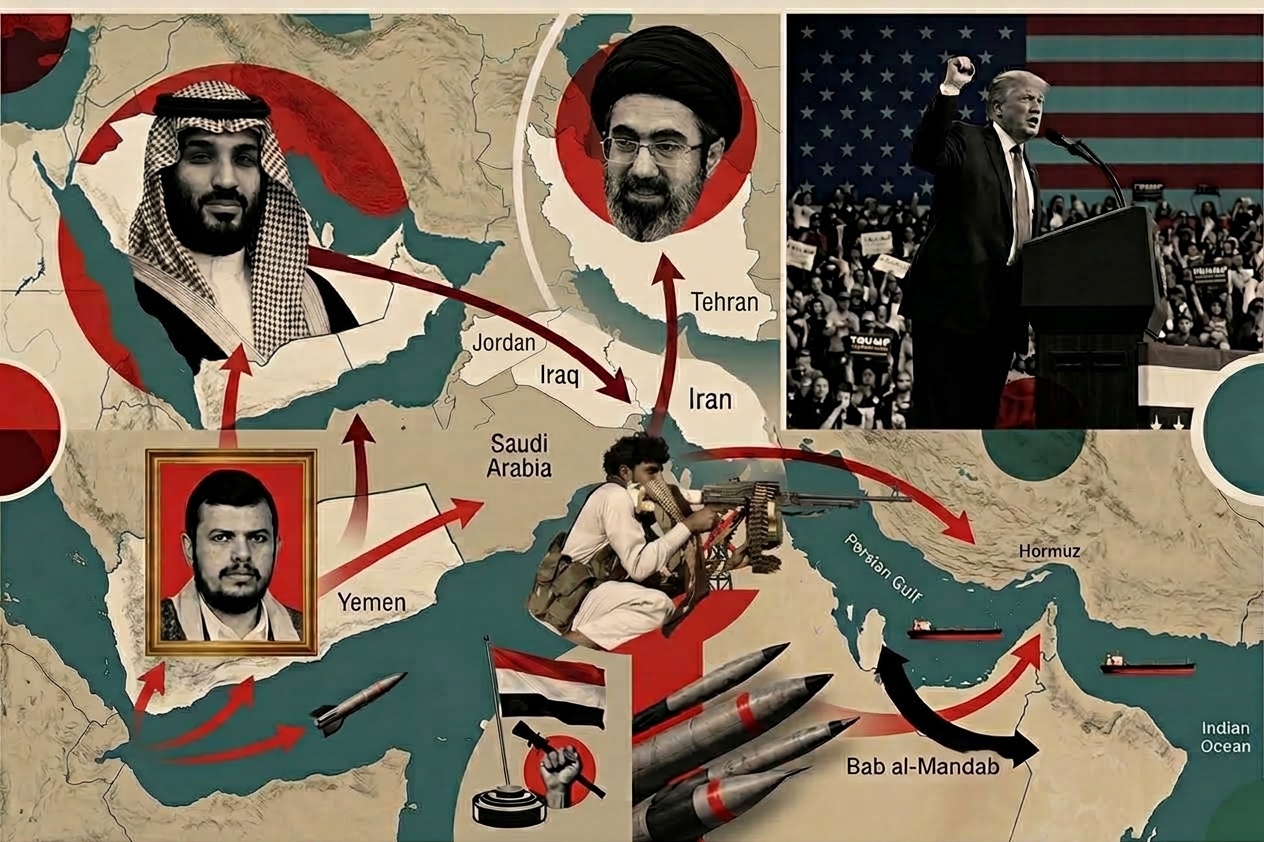
Since February 28, 2026, when the United States and Israel carried out a joint strike targeting the Iranian leadership and killing Supreme Leader Ali Khamenei, the Middle East has entered a cycle of war whose chapters have yet to conclude. That strike was not a passing event that could be contained within Iran’s borders alone. Rather, it was the spark that reordered the balance of power across the entire region, from the Strait of Hormuz in the east to Bab el-Mandeb in the west. What is happening today in Yemen cannot be separated from this broader context.
What Washington and Tel Aviv began under the cover of “preventing Iran from acquiring nuclear weapons” turned, within six months, into a multi-front regional war: Iran’s closure of the Strait of Hormuz, followed by a US counter-naval blockade, then a memorandum of understanding to end the war that quickly collapsed on July 8, sending the confrontation through an entirely new gateway.
Roots of the Crisis: From Sanaa 2014 to the Fragile 2022 Truce
To understand what is happening today, one must return to the starting point. The Houthis seized Sanaa in 2014 with the support of forces loyal to former Yemeni President Ali Abdullah Saleh, prompting Riyadh, at the beginning of 2015, to lead an Arab military coalition under the name “Operation Decisive Storm” to restore the Yemeni government. From that moment on, Yemen became an open arena of attrition between an axis led by Saudi Arabia and the UAE on one side, and a movement receiving increasingly substantial Iranian support in weapons, funding, and military expertise on the other. The war oscillated between escalation and negotiations for many years, until it produced a fragile UN-sponsored truce in 2022 that reduced the pace of fighting but failed to produce a genuine political settlement or dismantle the military arsenal the Houthis had built throughout those years.
And this is a crucial point that many overlook: the truce did not stop the flow of weapons. Instead, with Iranian assistance and smuggling networks spanning at least sixteen countries, according to investigations by arms-monitoring organizations, the Houthis continued developing advanced missile and drone capabilities, gradually transforming themselves from a local militia into a quasi-state force whose armament rivals that of the militaries of medium-sized states.
The 2026 Iranian War and Sanaa’s Initial Calculations: Why Didn’t the Houthis Move Immediately?
Here lies one of the most contentious points of this crisis, revealing the Houthis’ real logic more than the slogans of the “Axis of Resistance” do. When the war erupted at the end of February, the Houthis did not immediately rush to Tehran’s aid, despite pressure exerted on them by Iran and Hezbollah, which was itself engaged in its own war with Israel in Lebanon. Indeed, numerous reports spoke of a sharp internal split within the Houthi leadership between a hardline faction that wanted immediate involvement to consolidate the Houthis’ position within the “Axis of Resistance,” and another, more cautious faction fearful of dragging Yemen into a direct wave of American-Israeli retaliation, at a time when the areas under Houthi control still suffer from the destruction accumulated over years.
The Houthi calculations at that moment were more practical than ideological: the movement understood that the fall of the Iranian regime, or even its drastic weakening, would mean drying up its principal source of arms and, consequently, losing the leverage that had transformed it from a besieged militia into a regional player. It therefore limited itself during the first weeks to statements supporting Tehran and warnings that it would intervene if the war expanded or if the Red Sea were used as a platform for attacks on Iran, while in practice maintaining the “de-escalation” linking it to Riyadh since the truce. The Houthis did not actually break this cautious silence until March 28, when they launched their first missile toward Israel, officially declaring their entry into the war, but specifically against Israel, not against Saudi Arabia yet.
From Missiles at Israel to the Blockade of Saudi Arabia: The Turning Point in July
The real shift in the trajectory of this front came on July 13, when a dispute erupted over Riyadh’s refusal to allow an Iranian civilian aircraft to land at Sanaa airport. The Houthis used this as a pretext to resume direct attacks on Saudi Arabia, targeting facilities belonging to Aramco, ships bound for Saudi ports, and announcing what they described as a “naval blockade” of the kingdom through Bab el-Mandeb. From that moment, Yemen once again slid toward all-out war, with the truce that had endured for four years effectively collapsing.
More important than the timing was the motive: what happened was not simply an “opening of a front for Iran” as much as it was the Houthis reopening their own front, exploiting Riyadh and Washington’s preoccupation with the broader Iranian war. The movement is facing a worsening economic and humanitarian crisis in the areas it controls, as well as growing internal voices criticizing its mismanagement, giving it an additional incentive for an external escalation that could once again portray it before its popular base as a “force of confrontation,” rather than leaving it mired in domestic scrutiny over the failure of governance. In other words, the escalation against Saudi Arabia served Iran strategically, but it served the Houthis locally to the same extent, which is precisely what makes reading the crisis simply as an “Iranian proxy war” inadequate.
Control of Bab el-Mandeb: Repeating the Hormuz Scenario
Since mid-August, signs of the Houthi intention to “turn Bab el-Mandeb into a version of the Strait of Hormuz” began appearing openly in statements by field commanders within the movement. This was effectively achieved during the first week of September, when Houthi forces launched a broad offensive that led to the seizure of the strategic city and port of Mokha on the Red Sea after days of clashes with the “Giants” and “Nation’s Shield” forces loyal to the legitimate government, which were forced to withdraw southward. In less than twenty-four hours, Yemeni officials announced that the Houthis had taken control of “Mayun” (Perim) Island, which sits in the middle of the strait, along with the last islands that had remained outside their control, thereby completing Houthi control over the entire western coastline overlooking one of the world’s most important maritime passages.
The impact was immediate and tangible, as maritime traffic through Bab el-Mandeb fell to less than half its daily rate within a few days, according to data from maritime shipping-monitoring companies, while the port of Mokha came under retaliatory Saudi missile strikes targeting its airport. Specialized researchers described this trajectory as a deliberate Iranian-Houthi attempt to replicate the model Tehran applied in Hormuz, namely geographical control over one side of a vital waterway as a geopolitical coercion tool that can be activated or frozen depending on the course of broader negotiations with Washington. When Iranian officials conditioned the lifting of the blockade on Yemen, meaning an end to Saudi restrictions on Houthi-held areas and Sanaa, as part of any settlement with the Americans, it became clear that Bab el-Mandeb was no longer merely an internal Yemeni issue. It had become an Iranian bargaining chip par excellence.
The Barefoot Doctrine: How Poverty Engineered the Houthi Victory
From a purely military standpoint, the Houthis’ ability to achieve these rapid gains cannot be understood without grasping the radical transformation in their arsenal over recent years. The group that began in 2014 with obsolete Soviet missiles seized from Yemeni army stockpiles now possesses, according to investigations by organizations specializing in monitoring illicit arms, at least ten different types of ballistic and anti-ship missiles, in addition to air-defense systems, drones, and various naval weapons. Some of these were detected in maritime interdiction operations that uncovered more than eight hundred manufactured components and hundreds of tons of munitions. Most were not manufactured directly in Iran, but arrived as coded self-assembly kits carrying symbols and instructions for local production, indicating a high degree of logistical planning and cross-border supply networks that are difficult to detect.
Among the most prominent families of drones in use is the Samad series in its various versions, with ranges exceeding 2,000 kilometers in some variants. It is a design strongly resembling Iran’s Shahed drones, in addition to Wa’eed drones and explosive unmanned naval boats used as suicide projectiles against commercial and military vessels, as well as naval mines planted near narrow passages to disrupt navigation without the need to directly target every ship. More important than the quality of this weaponry is its low cost: some of these drones cost no more than $1,500 to manufacture, giving the Houthis the ability to launch repeated “attrition” attacks that conventional air defenses, originally designed to intercept threats that are much larger and more expensive, find difficult to match economically over the long term. This equation, cheap weapons draining expensive defenses, is the essence of what may be called a “war of technological decentralization,” which has redefined the balance of power in the Red Sea and made the Saudi coalition’s traditional air superiority less decisive than it was during the early years of the Yemen war.
On the ground, the Houthis relied in the western coastal battle on a tactic familiar in the literature of modern guerrilla warfare: avoiding direct confrontation in open flat areas where their opponent possesses superior mobility and air cover, while exhausting it through ambushes and severing supply lines in rugged mountainous and coastal terrain, then focusing on logistical choke points, such as the ports of Mokha and narrow coastlines, to isolate advancing forces from their rear. This is what I previously called the “Scoundrels’ Tactic.” This partly explains the relatively rapid collapse of the government’s defensive lines, which military analysts also attribute to internal divisions among factions loyal to the legitimate government and their competition for influence, rather than merely to pure Houthi battlefield superiority.
The East-West Pipeline and the Iraqi Fingerprint
On September 11, an attack by drones targeting pumping stations belonging to Saudi Arabia’s “East-West” pipeline in the Riyadh and Medina regions was announced. The attack caused injuries and material damage and prompted Saudi authorities to suspend the pipeline as a precaution. This pipeline is not merely a transit line, but the alternative artery Riyadh relies upon to transport its oil from the eastern fields to the port of Yanbu on the Red Sea, bypassing the Strait of Hormuz, which has been under blockade since the beginning of the Iranian war. This means that any strike against it threatens not only Saudi oil revenues, but also one of the last remaining arteries for Gulf energy exports independent of both the Hormuz and Bab el-Mandeb crises at once.
More damaging still, preliminary investigations confirmed that these drones were launched from Iraqi territory, specifically from Maysan Governorate in southern Iraq. This prompted Iraqi Prime Minister Ali al-Zaydi to issue a swift decision removing the Maysan Operations Commander, followed by the dismissal of the governorate’s police chief and the formation of a special investigative council, in addition to the temporary closure of the Shalamcheh border crossing with Iran, in an effort to contain the crisis diplomatically before it turned into a direct confrontation with Riyadh. It is necessary here to pause at the Saudi position itself, which, unlike its usual approach in similar previous cases, chose restraint and refrained from any military response at this stage, responding to an explicit request from the Iraqi prime minister to give Baghdad time to control the situation and hold those responsible accountable, while Riyadh simultaneously reaffirmed its “full sovereign right” to defend its territory and facilities should the incident recur.
This incident sums up Iraq’s structural dilemma at this entire stage: a country whose territory is shared by Iran-aligned armed factions and an official state seeking to maintain balanced relations with its Gulf surroundings, only for part of that territory to become, whether with or without the knowledge of the state, a launch platform in a regional war in which Iraq has neither stake nor share. The danger here is not limited to diplomatic embarrassment, but extends to the possibility that Iraq itself, in any subsequent escalation, could shift from a “cautious party” into an actual “battleground” if Baghdad loses its ability to control the irregular weapons spread across its south, just as Lebanon previously lost its ability to control the border with Hezbollah. The swift decisions taken by the Iraqi prime minister, despite their symbolic and procedural importance, remain an incomplete test of the Iraqi state’s sovereignty over the decision of war and peace within its borders, a test that will be repeated for as long as the regional war continues at Iraq’s doorstep from both Iran and the Gulf.
Washington Between a Pleading Ally and a War It Does Not Want to Expand
On the American side, confusion has been evident in recent days. According to converging reports from several agencies, Saudi Crown Prince Mohammed bin Salman called President Donald Trump twice in a single day, requesting in the second call that the United States launch direct strikes against the Houthis after their capture of Mokha. Trump rejected the request, limiting himself to a promise to provide Riyadh with intelligence and targeting data, while US officials explained that the president’s explicit instructions to their military and civilian leaders were to keep the American focus on Iran and protect freedom of navigation in the Strait of Hormuz, while avoiding the direct opening of a new military front, with around two hundred American military advisers in Saudi Arabia providing “non-combat” support. This refusal is not surprising when placed in its broader context: the American administration is already deeply involved in an open war with Iran that has lasted six months, with mounting financial and political costs, amid repeated discussion of a financial and military drain that has begun to concern even supporters of a hardline foreign policy toward Tehran. Opening a direct Yemeni front would, in practice, double the American commitment to a fight in which Washington has yet to prevail on its first front, not to mention that successive American administrations, regardless of party affiliation, have historically failed to settle the Yemen file militarily. It is a lesson that the White House appears to have absorbed this time, albeit at the cost of publicly embarrassing its Saudi ally. Added to that is the fact that Pakistan and Turkey, which together with Riyadh are partners in the “Mecca Mutual Defense Agreement” signed last month and which considers any attack on one of the three countries an attack on all, have so far chosen statements over action. Islamabad explicitly announced that there is “currently no discussion” of a military response and that it “will act when the time comes,” a restraint that reveals the fragility of the new regional alliances when confronted with their first real test.