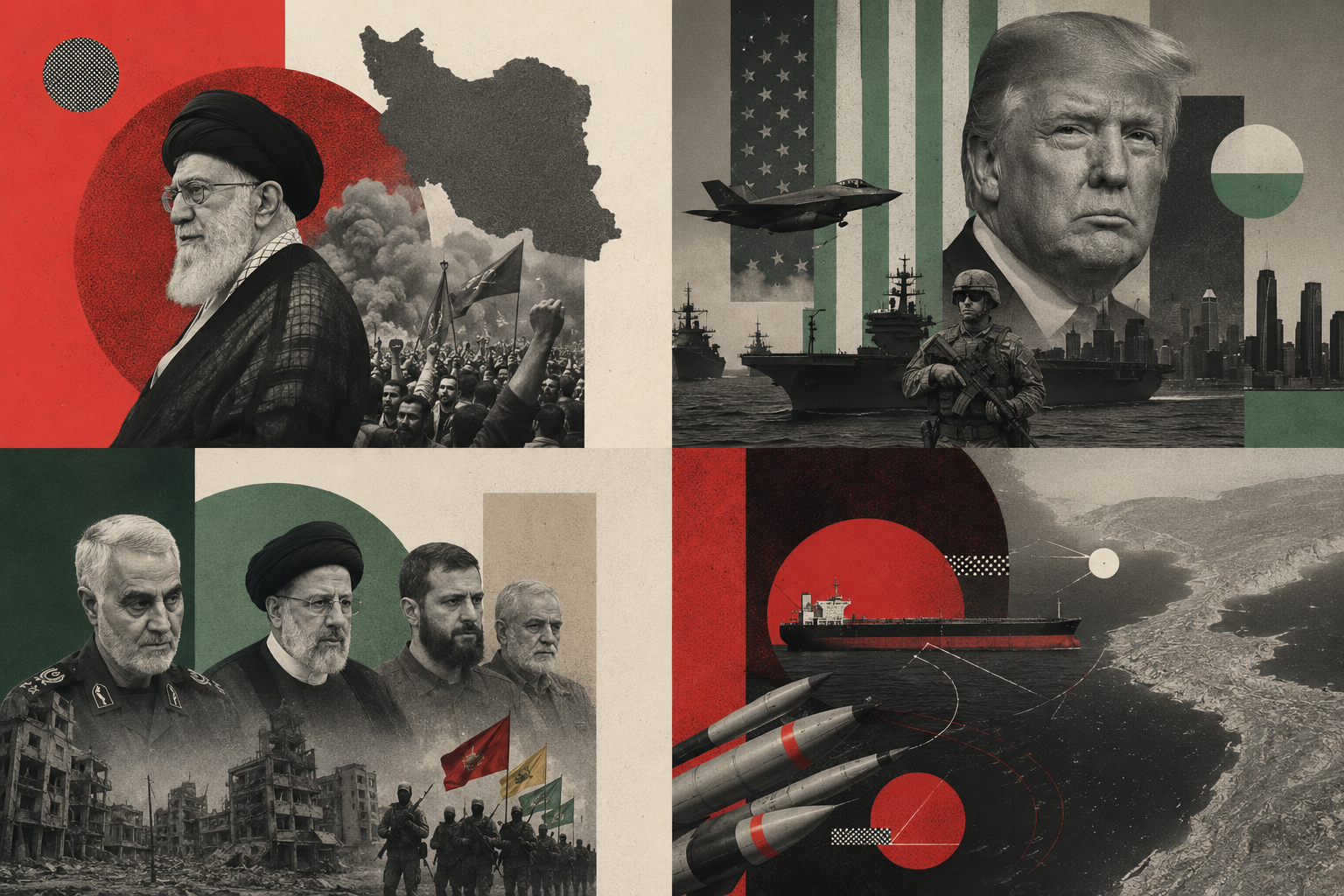
The war demonstrated that the United States, together with Israel, remains the party best able to inflict conventional military damage on Iran; yet this superiority did not automatically translate into political stability or into a clear capacity to shape a new regional order. Iran made no attempt to compete with Washington on the terrain of conventional strength; instead, it set out to distribute the costs of the war beyond the immediate battlefield, targeting Washington's Gulf allies, unsettling their image as safe havens for investment and supply, pressuring energy installations, and draining America's stockpile of interception and defense systems. In this way, the limits of a notion of military victory measured solely by the number of strikes or the scale of destruction stood exposed; the militarily weaker party managed to wield the political economy of war as a counter-deterrent, shifting the essence of the equation from the question of "who possesses greater destructive power?" to the question of "who can distribute the cost and prolong the ambiguity?"
From here the gap between military decisiveness and political arrangement becomes clear; striking command centers, dismantling the missile arsenal, and exhausting defenses do not by themselves produce lasting peace or a new regional order. The American experience in the region has furnished repeated examples of this gap, for air and military power can weaken an adversary and disrupt its systems, yet it still requires a political vision for the post-war phase before battlefield achievement can turn into real stability. The ongoing American debate reflects this hesitation plainly: is the goal to push Iran toward a new settlement? To rebuild long-term deterrence? Or to exhaust its regional influence without engaging in a project of political reconstruction? This ambiguity in defining the strategic objective has yielded a military outcome that remains incomplete from the standpoint of building a regional order, however great its battlefield strength.
This axis can be viewed from a broader angle concerning the structure of American power itself; Washington remains capable of tactical decisiveness, yet its capacity to engineer the political environment that follows wars is receding — a recession that does not appear peculiar to Iran alone so much as it reflects a wider pattern in the relationship between American military power and its political outcomes in the region. This war therefore exposed the limits of a model that assumes the intensity of strikes alone suffices to rearrange the region; what the Iranian case demonstrated is that the militarily stronger party can curtail its adversary's immediate capacity, but it needs more flexible political, economic, and coalitional tools to convert that into stability. In this sense, Washington retained its battlefield superiority, while its capacity to produce a sustainable regional order remained an open question.
The Scattering of Command Structure: Transformations of the "Axis of Resistance" After the War
The greatest analytical error lies in treating Iran's networks of influence as a single bloc, uniform in movement and function; this war revealed that what is known as the "Axis of Resistance" does not collapse all at once under pressure, nor does it continue in the same pattern after absorbing a strategic shock — what actually occurred was a shift from a centralized proxy model to a more flexible, dispersed model of repositioning. Before the war, these networks were read as a regional arm of Iran, managed through calculated escalation from the center. Afterward, however, indications emerged of a redistribution of authority, an expansion of the margin for field initiative, and a rise in operational decentralization, particularly in the Iraqi arena; recent reports indicate that Tehran granted its field commanders there a wider margin of control over the factions, allowing some of them to act without direct authorization from the center — a striking sign of a shift from strict centralization to flexible guidance under the weight of war.
These networks no longer move by the logic of unified loyalty that once bound them before the war; rather, the degree of their attachment to the Iranian center has varied, depending on the depth of their ideological roots on one hand, and the scale of their own local agendas on the other. Some remained tightly bound to Tehran ideologically and in security terms despite the pressure; others used the cover of their relationship with Iran to serve broader local calculations that do not fully dissolve into Iranian decision-making; while a third set of components maneuvered between the local and regional arenas according to circumstance, shifting fluidly among military, political, and social roles. This variation in the degree of integration is what makes a post-war reading more precise, since a single strike does not produce the same effect on a structure that was never homogeneous to begin with.
This adaptive capacity is inseparable from the fact that a portion of these factions in Iraq specifically are no longer merely a parallel force to the state, but are embedded in its security and financial joints, or backed by entrenched political influence, or resting on a store of legitimacy earned earlier in the fight against ISIS. For this reason, targeting them militarily does not equate to dismantling their presence within the internal equation; external pressure may in fact produce the opposite result, as these forces resort to entrenching their institutional presence further or integrating more deeply within state apparatuses, complicating any attempt to contain them. At the same time, the expansion of field commanders' authority, even as it weakens strict organizational discipline, grants these networks a higher tactical flexibility that makes it harder for external adversaries to monitor, target, or effectively encircle them — unlike internal actors familiar with the environment of these factions, their combat doctrine, and their patterns of movement, whose deep operational knowledge grants them a qualitative capacity to read and contain their movements that no external party possesses, however great its technical or intelligence superiority.
The Double-Edged Sword of Hormuz: Between Deterrence and Strategic Suicide
The Strait of Hormuz stands at the heart of this picture as an asymmetric instrument of deterrence; Tehran did not need to close it entirely to achieve its strategic effect — raising the level of risk and threatening the movement of shipping and maritime insurance sufficed, immediately shifting the cost onto the global economy, energy markets, and Washington's regional allies. In this way the war came closer to being a struggle over the region's economic environment than a limited military confrontation; when energy and maritime corridors turn into leverage, war becomes a tool for undermining regional confidence and disrupting the calculus of international protection, burdening Washington with responsibilities that extend beyond managing the battle itself to managing a long chain of economic and diplomatic consequences.
Yet overplaying this card may turn the equation on its head, causing Tehran — at the very peak of its grip on the levers of power — to lose the fragile peace that followed the war. The memorandum of understanding signed between Iran and the United States chose, whether by design or by necessity, to defer resolution of the thorniest files, foremost among them the restrictions imposed on Iran's nuclear program, to a negotiating window not exceeding sixty days. The file of the Strait of Hormuz specifically, however, appears far more complex than many who wager on settling it easily imagine. The memorandum limits itself to guaranteeing safe, free passage for commercial vessels during this window, while the question of the strait's future management after the war is left suspended, tossed between Tehran's calculations — and perhaps Washington's as well — without clear resolution. But whether a final agreement is reached or the negotiations falter, Iran has not concealed its intention to impose new restrictions and fees on vessels transiting the strait once this window expires. This was stated by the head of the Iranian negotiating delegation, parliament speaker Mohammad Baqer Qalibaf, who declared with striking candor that "the Strait of Hormuz will not go back to what it was," adding that it is "only natural that we charge fees for the services we provide" — a statement carrying more strategic significance than technical or procedural content. In this way, the Strait of Hormuz may turn into a flashpoint of instability in the post-war phase. And just as Trump overestimated his strategic advantage when he launched the war, Tehran may now be on the verge of committing that same error after its end.
The Search for Alternatives: Can Hormuz Be Dispensed With?
This dynamic is likely to push regional states to accelerate their steps toward finding alternative corridors that avoid passage through the strait — a costly move that drains time and effort, yet one that becomes inevitable so long as the strait does not operate at full, unrestricted capacity. And even if the war's experience revealed just how difficult it is to find genuine alternatives to this passage, that will not deter Gulf states from proceeding to invest in new energy infrastructure freed from dependence on the strait. Along the same lines, Iran's insistence on barring the passage of warships appears unsustainable for long; the United States and France maintain major naval bases in the Arabian Gulf that can be reached by no route other than this strait — bases that form an indispensable pillar for the security of the entire region.
Nor are these efforts entirely new; there are already infrastructure projects in place or under expansion that reflect serious, if partial, attempts to circumvent the strait:
Saudi Arabia's Petroline (East-West Pipeline): This runs from the oil fields of the Eastern Province to the Red Sea port of Yanbu, with a capacity of nearly five million barrels per day, allowing Riyadh to export a large share of its oil without passing through the strait at all.
The UAE's Habshan-Fujairah Pipeline: Built by Abu Dhabi specifically to transport oil from inland fields to the port of Fujairah on the Arabian Sea, bypassing the strait entirely, with a capacity of about 1.5 million barrels per day.
Iraq's Alternative Routes: Iraq, which relies almost entirely on exports through the Gulf, is seeking to activate alternative routes via Turkey (the Kirkuk-Ceyhan pipeline) or via Jordan and Saudi Arabia, although these options have remained of limited effectiveness due to recurring political and technical disputes.
Omani Proposals: By virtue of its direct outlook onto the Arabian Sea from outside the strait, Oman holds the potential for its ports (such as Salalah and Duqm) to become alternative transit points — a prospect Gulf states are seeking to invest in as a possible diversion corridor for oil and gas.
Yet the fundamental problem with all these alternatives lies in the fact that they require massive infrastructure investment, and their capacity is limited to only a fraction of the total exports that normally pass through Hormuz — which makes them complementary rather than a complete substitute for the strait.