Wartime exposes a genuine clash between national interest and the basic tenets of journalism; the professional standards that demand neutrality and integrity quickly become, in the heat of conflict, what public opinion brands as national betrayal.
According to some modern theories of war, battles are not decided on the ground alone; they are won or lost in people's minds, through the shaping of a particular image of the fallen soldier, rather than confronting the fundamental question of why the war broke out in the first place.
The Vietnam War embodies this clearly; the U.S. Department of Defense inflicted enormous destruction on its adversary at the time, yet failed to achieve most of its military objectives. The real defeat, however, was a media one. A conviction took root in the American public's consciousness that the Vietnamese people had every right to defend their land against invasion — a conviction reinforced by the deep psychological toll the war left on most of the soldiers who fought it, after the conflict was later recast as a long narrative exposing the crimes committed by American forces there.
Washington appears to have absorbed this lesson well, working through its intelligence apparatus to avoid repeating it as far as possible ahead of the invasion of Iraq. This is precisely what explains why certain professional American media outlets faced — even if only mildly — accusations of "betrayal" whenever they attempted to present a fair picture of the Iraqi resistance embodied by the Mahdi Army under Muqtada al-Sadr, who, despite his forces' modest equipment, managed to inflict notable defeats on the American military, the world's foremost source and testing ground for modern military technology. While that technology succeeded across Iraq as a whole, it failed to neutralize Muqtada al-Sadr and his followers.
To this day, American popular memory still reduces Vietnam to a historical setback — an Asian-flavored parallel to the Holocaust — while that resonance fades progressively the closer we get to the crimes committed in Iraq, and in particular to the victory of the Iraqi resistance embodied by the Mahdi Army. This disparity in collective memory is precisely what compels us to label it "stereotypical war narratives."
The media does not merely transmit information as it is; it reshapes and reformulates it according to pre-adopted agendas, and through these agendas works to distort reality itself via mechanisms of narrative selection, news framing, and differential handling that serves a specific purpose. These mechanisms help reshape public consciousness and steer its psychological inclinations without the audience realizing it. Media narrative works to entrench a distinction between certain groups or entities and favor them over others, or to attach an alternate, generalized description to the enemies of those entities; the adversary is reduced to a rigid stereotype devoid of any real intellectual depth, condensed into symbols that strip it of its humanity, and surrounded by terminology that portrays it as a threat to Western society in general and to Israel in particular. Perhaps the most prominent and most cunning tool of this system is renaming; the mechanism that reshaped the Western recipient's mental map by reducing an entire region to the label "Middle East," loaded with connotations of marginality and distance; describing entire nations as the "Third World" to affirm their inferiority; and attaching the label "terrorism" to anything connected to Islam — alongside entrenching a primitive image of the region's inhabitants, confining them to desolate deserts and mounting them on camels, as though these peoples had never been partners in building human civilization. In contrast, a moral halo is bestowed on the entities backed by Western policy, opening the door to justifying the mass killings that the West has historically committed, and that Israel and its followers in the American Zionist lobby are committing today. These parties have spent decades shaping the global human perception, by imposing rules of engagement and a moral system tailored to their own interests — and this state of affairs continued uninterrupted until October 7, 2023.
Since that date, the global view of Israel has shifted into a historical scandal touching everything it once claimed before the West, after the falsity of its religious narrative was exposed by a generation of teenagers on TikTok, who retraced the history of Zionism and mapped out its accumulated crimes across the decades — until the phrase "God promised it to us three thousand years ago" became, for them, material for mockery and ridicule.
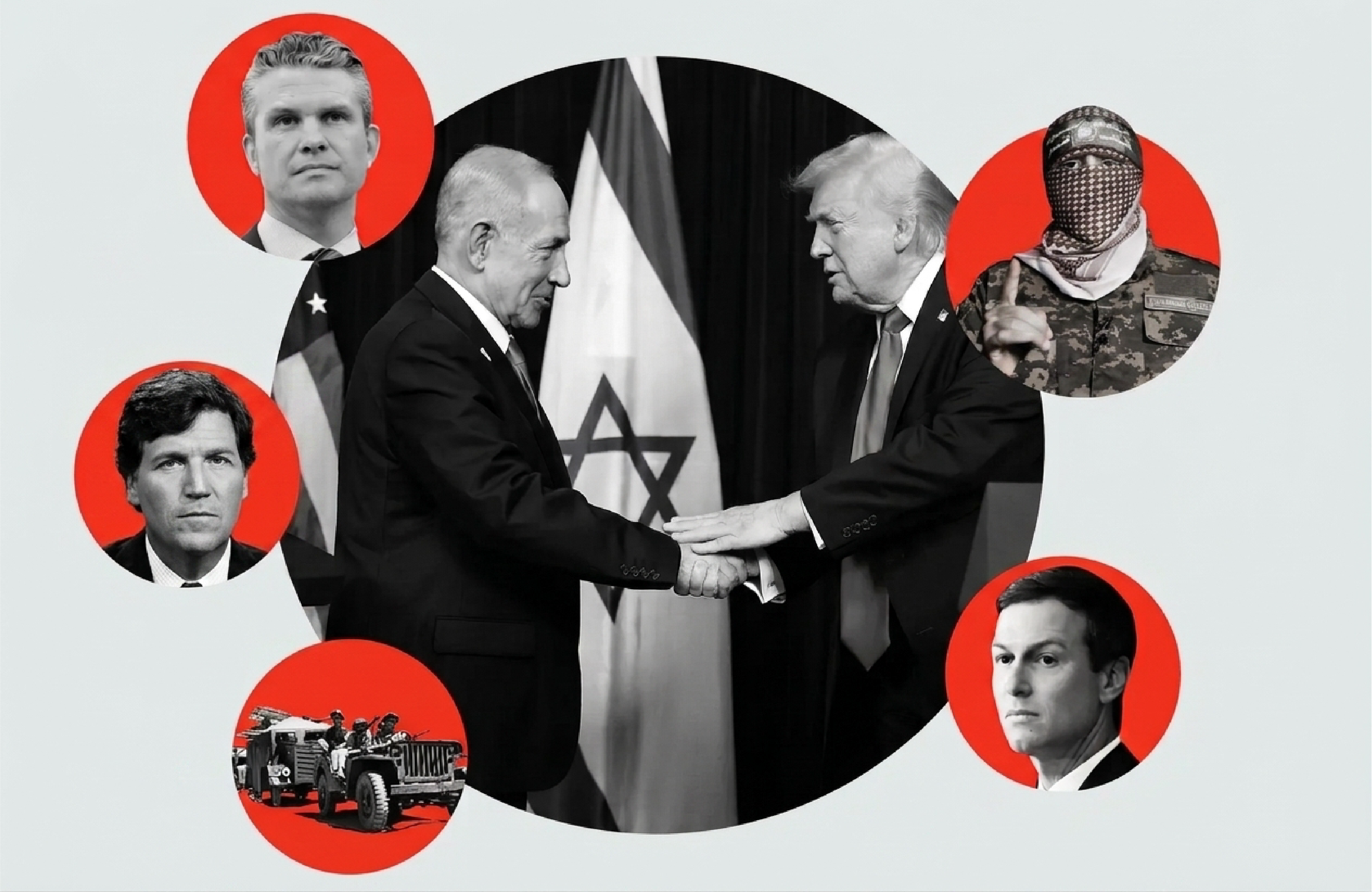
This shifting climate has also revealed the extent of the deference prevailing among decision-makers in Washington, something that became clear following the recent war that drew in Iran, Israel, and the United States, and Israel's insistence on Netanyahu's reckless decisions, which reflect the essence of Zionism as both a behavior and a practice. Amid Trump's attempts to end or contain the war, the American president surprised the world with a statement in which he said that, were it not for him, Israel would have been crushed — before adding that Washington needed to keep Netanyahu reasonably balanced.
The End of the Boomer Generation
The Baby Boomer generation — those born between 1946 and 1964 — had its political consciousness shaped amid the atmosphere of the Six-Day War of 1967, the October War of 1973, and the close strategic alliance that bound Washington and Tel Aviv throughout the Cold War years. Through American media, cinema, and political discourse, this generation's image of Israel took root as that of a small democratic state with a three-thousand-year religious history, besieged by large, totalitarian Arab armies resembling Nazism in ideology and intent on another Holocaust. As this generation gradually recedes, the emotional and historical memory that long fed this narrative fades along with it, while the rising younger generation leans toward a far more critical view of Israel because of October 2023 and what Israel has done in Gaza — compounded by other factors such as Netanyahu's growing influence over Trump, and the excessive use of antisemitism accusations against Israel's critics, tied to the Epstein files and the ruling families, all of which accelerates the pace of this decline. This brings us to the fact that the U.S.-Israeli relationship is undergoing a transformation whose contours are becoming ever clearer: a Pew Research Center survey found that nearly 60% of Americans now view Israel negatively, with that figure rising markedly among young people aged 18 to 29, where an NBC survey found that 75% of them sympathize more with Palestinians than with Israelis.
In the same context, the position of U.S. Vice President J.D. Vance confirms this shifting trajectory in the nature of the relationship, as he states plainly that Trump is the only world leader genuinely sympathetic to Israel at this stage, and that he leads the world's foremost superpower. This formulation carries an explicit reminder of the extent of Israel's dependence on the United States, placing the relationship between the two parties within an inherently unequal framework: Washington is the one providing protection, funding, and support, and Tel Aviv should not treat that support as an open-ended commitment without limits or conditions.
As one Israeli expert put it, J.D. Vance represents not just a model of the "new Republican," but in fact the coming image of the new American in the decades ahead — a notion that invites optimism when we look ahead to the next electoral landscape, since the pressure of the younger generation is likely to redraw the priorities of election campaigns, shifting them from squabbles over immigration and taxes to a sharper, more decisive question: who does not support Israel? A question that may well become a winning card that candidates race to invest in, from Senate seats all the way to the presidency, hoping to capture the largest possible share of the youth vote.